






The artificial intelligence revolution is running on overdrive, but its progress is tethered to an earthly problem: an insatiable hunger for energy and land. This has sparked a radical idea: moving data centres to orbit. But what does it mean for science?
AI’s Unquenchable Thirst
Artificial intelligence is reshaping our world, but this digital transformation has a massive physical footprint. The complex calculations required to train large language models and run AI applications demand enormous, power-hungry data centers. These facilities, which can occupy millions of square feet, are straining electrical grids worldwide. Projections from the International Energy Agency suggest that electricity consumption from data centers could more than double by 2030, with AI workloads being the primary driver. This surge is creating a bottleneck; there simply isn't enough power or land in some regions to keep up with the demand. This terrestrial limit has some of the biggest names in technology looking toward the sky for an audacious solution.
The Solution: Data Centres in Orbit
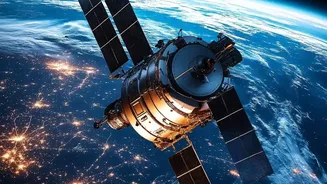
The concept of a satellite data centre megaconstellation sounds like science fiction, but it's being explored as a serious possibility. The idea involves launching thousands, or even hundreds of thousands, of satellites that function as interconnected data centers. In early 2026, for instance, SpaceX filed plans with the US Federal Communications Commission (FCC) for a constellation of up to one million satellites designed for this purpose. Proponents argue that space offers two huge advantages: near-constant solar power and a naturally cold environment. By placing data centers in orbit, they could be powered by the sun, freeing them from the constraints of terrestrial power grids and reducing their reliance on the freshwater often used for cooling on Earth.
A Collision Course with Science
While the tech industry sees potential, the astronomy community sees a looming crisis. For years, scientists have warned about the impact of existing satellite megaconstellations like Starlink. These orbiting objects reflect sunlight, creating bright streaks across the night sky that contaminate images from ground-based telescopes. This light pollution is particularly disruptive for research that requires twilight observations, such as the search for near-Earth asteroids. Beyond visible light, these constellations also pose a major threat to radio astronomy. Satellites emit radio signals that can be orders of magnitude stronger than the faint cosmic signals astronomers are trying to detect. Studies have shown that even unintentional 'leaked' radiation from satellite electronics can interfere with protected radio astronomy frequencies, effectively blinding sensitive telescopes.
An Increasingly Crowded Sky
The scale of proposed orbital data centers would amplify these problems exponentially. A sky filled with hundreds of thousands of new satellites would fundamentally alter the night sky for everyone on Earth. If such a large number of satellites are deployed, no combination of mitigations could fully prevent the impact on astronomical science. The problem isn't just about streaks in photos; it's about a cumulative brightening of the night sky and a constant barrage of radio frequency interference (RFI) that could make entire fields of research impossible. This creates a direct conflict: the push for limitless AI computing power versus the preservation of our ability to observe the universe from Earth. Currently, there is a lack of international regulation governing the unintentional emissions or brightness of satellites, leaving astronomers with few options but to appeal to companies and regulators.
The High Cost of an Orbital Future
Beyond the astronomical impact, significant technological and economic hurdles remain. Launching hardware into space is incredibly expensive, and maintenance presents a monumental challenge. Unlike a terrestrial data center where a faulty server can be swapped in minutes, a broken satellite is often just a new piece of space debris. Furthermore, while space is cold, dissipating heat in a vacuum is not straightforward and requires specialized radiation systems. The hardware would also be exposed to damaging cosmic radiation, requiring heavy shielding that adds to launch costs. Analysts suggest that even with optimistic projections for cheaper launches, orbital data centers will likely remain more expensive than their Earth - bound counterparts for the foreseeable future, making them viable only for specific, high - value uses like processing sovereign data or supporting military applications.