






A Rare Celestial Spectacle
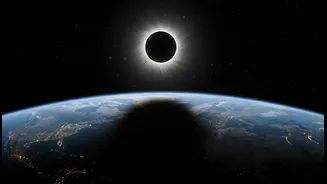
A total solar eclipse is a breathtaking cosmic alignment where the Moon passes directly between the Earth and the Sun, completely obscuring the Sun's bright face. For a few brief, wondrous minutes, day turns to an eerie twilight, and the Sun's ethereal
outer atmosphere, the corona, becomes visible to the naked eye. The 2026 event is particularly noteworthy as it will be the first total solar eclipse visible from mainland Europe since 1999. The path of totality will begin over remote parts of the Arctic and Greenland before sweeping across western Iceland and finally making landfall over northern Spain in the evening. Cities like Bilbao and Palma will be plunged into darkness for just over two minutes, offering a rare celestial show against a setting sun. While the full spectacle is confined to this narrow path, a partial eclipse will be visible across a much wider region, including most of Europe and parts of North Africa.
The View from India: A Night Sky Affair
For sky-gazers in India, the August 12, 2026, eclipse will be an event experienced from afar. The eclipse will occur during nighttime hours across the Indian subcontinent, making it impossible to view directly. According to time calculations, the eclipse will unfold between approximately 9:45 PM and 2:15 AM Indian Standard Time (IST). Because the event is not visible from India, traditional Hindu customs and rituals associated with a 'Surya Grahan', such as Sutak Kaal, will not be applicable. This might seem disappointing, but the lack of direct visibility is precisely what shifts the focus from a local viewing event to a global scientific and cultural moment—one in which India has a significant, albeit different, role to play.
India’s Scientific Stake in the Sun’s Shadow
While the general public won't see the eclipse, India's scientific community will be deeply engaged. India has a long and storied history of astronomy, from the ancient astronomer Aryabhata who provided a scientific explanation for eclipses in the 5th century, to today's advanced space missions. The country's solar physicists are key players on the global stage. Total solar eclipses offer a rare opportunity to study the Sun's corona, the super-hot outer atmosphere that is usually invisible. Understanding the corona is crucial for learning about solar flares and coronal mass ejections (CMEs), which can impact Earth's technology and space weather. Indian teams, like those from the Aryabhatta Research Institute of Observational Sciences (ARIES), have previously travelled to eclipse paths to conduct experiments. These ground-based observations are often designed to complement data from space missions. This eclipse will be a prime opportunity to coordinate observations with India's own solar observatory, Aditya-L1.
Aditya-L1 and the Global Scientific Chorus
India's Aditya-L1 mission, successfully positioned at the Lagrange Point 1 (L1) about 1.5 million km from Earth, has a continuous, uninterrupted view of the Sun. This is a huge advantage, as it isn't affected by earthly eclipses. During the 2026 eclipse, as ground-based telescopes in Spain and Iceland study the inner corona revealed by the Moon's shadow, Aditya-L1 will simultaneously observe the Sun's outer layers and solar wind from its unique vantage point. By combining data from ground observations during the eclipse with the space-based data from Aditya-L1 and other international probes, scientists can build a more complete, three-dimensional picture of the Sun's atmosphere. This collaborative approach is what the headline's 'Global Totality' truly signifies: a worldwide scientific effort to unlock the Sun's secrets, with Indian instruments and intellect playing a vital part.
How to Experience the Eclipse from India
Thanks to modern technology, no one has to miss out on the experience. The most useful angle for the Indian public is the ability to join the spectacle virtually. Major scientific organisations like NASA and the European Space Agency (ESA), along with educational institutions such as the Exploratorium, will host high-quality live streams of the eclipse. These webcasts will feature multiple telescope feeds from different locations along the path of totality, from Iceland to Spain, complete with expert commentary explaining the science as it happens. This digital access transforms a geographically limited event into a shared global moment of wonder. It allows anyone with an internet connection in India to witness the awe-inspiring sight of the Sun's corona and feel connected to the millions of people watching across the globe, embodying the spirit of 'Global Totality.'