



The Classic Distinction
Traditionally, the solar system's small bodies were split into two main camps: asteroids and comets. Asteroids are primarily rocky and metallic objects, most of which live in the asteroid belt between Mars and Jupiter. They are considered relatively inactive.
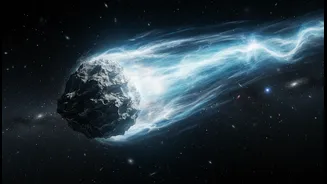
Comets, on the other hand, are often called "dirty snowballs" because they are composed of ice, rock, and dust. Hailing from the frigid outer reaches of the solar system, like the Oort Cloud, comets become active as they approach the sun. The heat causes their ices to sublimate—turn directly into gas—creating a glowing cloud called a coma and the iconic tail that can stretch for millions of kilometres.
Enter the Hybrid Objects
Recent discoveries have challenged this neat division. Scientists are finding objects that don't fit cleanly into either category. One such class is the "Manx comets," named after the tailless cat breed. These objects have the long, looping orbits of a comet that takes them far out into the solar system, but they lack the characteristic tail because they appear to be rocky and have very little surface ice. One theory suggests they are inner solar system bodies that were flung into the outer solar system long ago, essentially preserved in a deep freeze. Their existence blurs the line between a rocky asteroid and an icy comet, suggesting a continuum rather than a simple binary.
The Mystery of Dark Comets
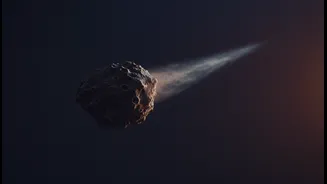
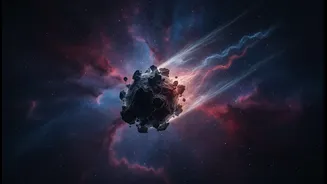
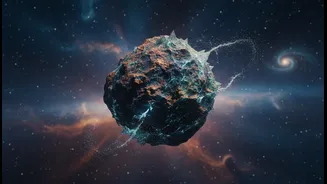
Even more puzzling are the recently identified "dark comets." These objects look like asteroids and show no visible coma or tail. However, they move in ways that gravity alone cannot explain. They experience a small, non-gravitational push, which scientists believe is caused by the outgassing of subsurface ice that isn't visible to telescopes. This behaviour is classic for a comet, yet visually they are just dark rocks. The first hints of such objects came from the interstellar visitor 'Oumuamua in 2017, which accelerated like a comet without having a tail. As of late 2024, astronomers had identified 14 such dark comets within our solar system, sorting them into two families based on their size and orbit.
When 'Inactive' Isn't Inactive
The existence of dark comets points to a bigger issue: a space rock that appears inactive might not be. A comet can become "dormant" when it expels most of its surface volatiles, or when a crust of dust and rock forms on its surface, trapping any remaining ice underneath. This object would look like an asteroid but could become active again. For astronomers, this is where the classification challenge comes to a head. An object’s label “succeeds” or fails based on our ability to detect this subtle activity. This re-evaluation is critical, as our understanding of an object's composition and behaviour depends on its classification.
Why the Labels Matter
Correctly classifying these small worlds is not just an academic exercise. These objects are remnants from the birth of our solar system 4.6 billion years ago, and their composition holds clues to how planets, including Earth, were formed. Some scientists believe dark comets, which may have subsurface ice, could have been a source for delivering water and the organic molecules necessary for life to early Earth. Furthermore, from a planetary defense perspective, knowing what an object is made of is crucial. The trajectory and potential impact of a solid rock (an asteroid) are different from that of an object that is actively outgassing (a comet), which can alter its own path. Understanding these mysterious objects helps us both piece together our past and protect our future.