



The Galaxy's Sleeping Giant
Contrary to their popular image as cosmic vacuum cleaners, most supermassive black holes are not actively devouring everything around them. These behemoths, with masses millions or even billions of times that of our Sun, often spend long periods in a quiet,
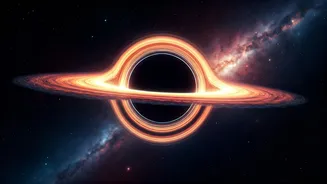
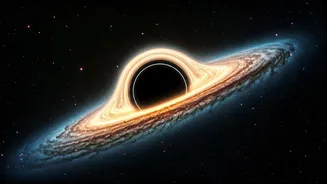
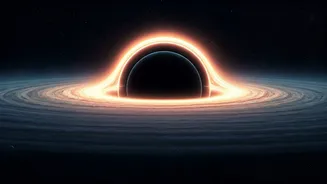
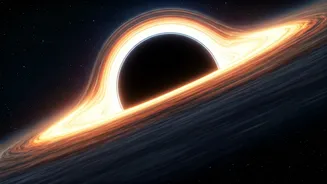
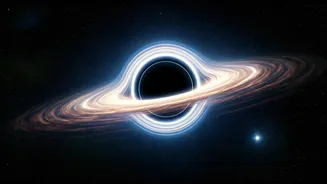
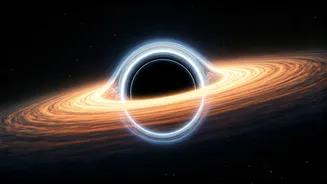
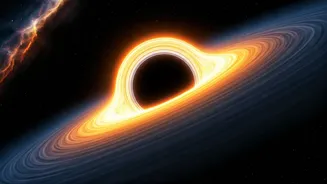
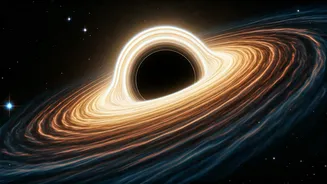
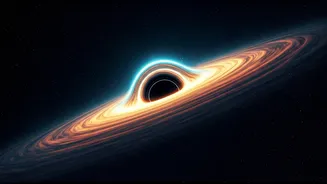
inactive phase. In this dormant state, they are incredibly difficult to see directly. They are simply gravitational anchors, silently holding their host galaxies together. A small amount of gas may swirl around them in what's called an accretion disk, but for the most part, the dinner table is empty, and the giant sleeps peacefully.
An Unprecedented Awakening
In late 2019, astronomers noticed something strange happening in a galaxy called SDSS1335+0728, located about 300 million light-years away. After decades of being unremarkable, the galaxy's core suddenly started to shine brighter than ever before. Its brightness has continued to increase over the last several years, an event unlike typical short-lived cosmic flare-ups like supernovae. After extensive observation, scientists have concluded they are witnessing a massive black hole, about one million times the mass of the Sun, suddenly 'switch on' in real-time, a process that has never been observed so clearly before.
The Cosmic Buffet Arrives
So, what wakes a black hole? The answer is food. The awakening is triggered when a large supply of gas and dust becomes available for the black hole to consume. For years, a leading theory was that black holes fed on a slow, steady diet of hot gas from their galactic halos. However, newer observations show a much more chaotic process. Using advanced observatories like the Atacama Large Millimeter/submillimeter Array (ALMA), astronomers have seen that black holes can also gorge on a clumpy, messy downpour of very cold molecular gas clouds. These vast clouds, sometimes described as a 'cosmic rainstorm', coalesce out of hotter intergalactic gas and plunge toward the galaxy's center.
A Messy Eater with Spiral Arms
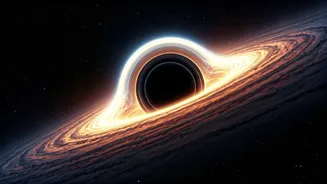
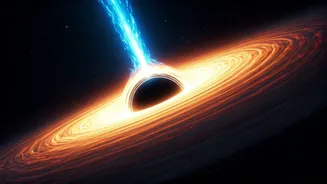
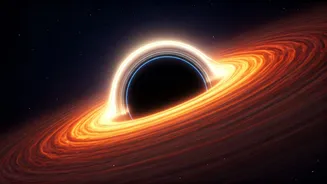
Getting the gas to the black hole isn't simple. The material has to lose momentum to fall inward. Recent studies of the Circinus Galaxy have revealed a potential solution: giant spiral arms of gas that act like channels, funneling material from a large disk toward the black hole's inner region. But supermassive black holes are notoriously messy eaters. As gas spirals inwards, the environment becomes incredibly extreme, heating the material until it glows intensely, creating the bright phenomenon known as an Active Galactic Nucleus (AGN). Much of the gas doesn't make it into the black hole; instead, it's blasted away by powerful winds and jets, a process that shapes the evolution of the entire galaxy.
Catching It in the Act
Observing this process is a triumph of modern astronomy. A combination of ground-based and space telescopes, including the European Southern Observatory's Very Large Telescope and NASA's Swift X-ray telescope, has been used to track these changes. In the case of the recently awakened black hole, astronomers began detecting powerful, repeating bursts of X-rays in early 2024. These flashes, called quasi-periodic eruptions (QPEs), are a tell-tale sign of a black hole actively feeding. The ability to observe this entire 'waking up' process provides an unprecedented opportunity for astronomers to understand the lifecycle of these cosmic giants in real time.
Why This Matters for Us
Studying how black holes feed isn't just about understanding distant, exotic objects. This process of accretion and the subsequent outflow of energy are fundamental to how galaxies evolve. The energy blasted out by a feeding black hole can either trigger or shut down the formation of new stars in its host galaxy. By witnessing a black hole's awakening, scientists can refine their models of galaxy formation, which helps explain the history of not only distant galaxies but also our own Milky Way. Some scientists even note that our galaxy's own central black hole, Sagittarius A*, could potentially undergo a similar awakening in the future.