

The Great Lunar Freeze
A lunar night is not just a brief period of darkness; it's a marathon of extreme cold that lasts for approximately 14 Earth days. With no atmosphere to trap heat, the Moon's surface temperature can drop to a staggering minus 173 degrees Celsius (-280
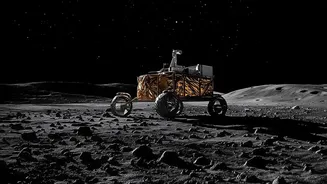
degrees Fahrenheit) near the equator. In the permanently shadowed regions near the poles, which are of great scientific interest, it gets even colder, reaching temperatures that can dip below -250°C. This profound cold is lethal to standard electronics, batteries, and mechanical systems. The delicate circuits that serve as a rover's brain would fail, batteries would lose their ability to hold a charge, and lubricants would turn to paste, seizing moving parts. For any long-duration mission, simply surviving this recurring deep freeze is the first and most critical hurdle.
The Nuclear Option: A Steady Warmth
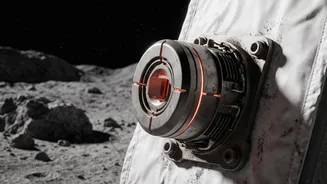
One of the most reliable solutions for keeping a rover's core components from freezing is the Radioisotope Heater Unit, or RHU. These small devices, often about the size of a C-cell battery, act like tiny, long-lasting furnaces. They contain a small pellet of plutonium-238, a material that naturally releases a steady amount of heat as it radioactively decays. This process provides a constant, gentle warmth for decades without needing any electrical power or moving parts, making RHUs incredibly robust. China’s Yutu and Yutu-2 rovers successfully used RHUs, combined with folding their solar panels to trap heat, to endure multiple lunar nights. While highly effective, RHUs are complex and expensive, driving engineers to develop alternative strategies for missions that can't carry a nuclear heat source.
Smart Hibernation and Thermal Control
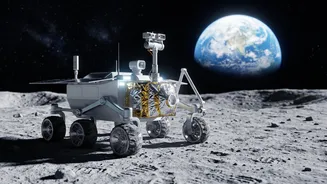
For missions without RHUs, survival depends on a combination of clever insulation and power management. The strategy involves creating a highly insulated 'warm box' to house the most sensitive electronics. This box is thermally isolated from the rover's main frame to minimize heat loss. NASA's upcoming Volatiles Investigating Polar Exploration Rover (VIPER) is a masterclass in this approach. It uses a sophisticated system of Loop Heat Pipes (LHPs) and radiators to manage its temperature. During the lunar day, the system actively sheds excess heat from the electronics. But as night falls, special passive control valves shut off the heat rejection, effectively trapping the residual warmth inside the rover to keep its components from freezing. This allows VIPER to hibernate through the coldest periods, conserving precious battery power.
Chasing the Sun and New-Age Insulation
Another strategy, particularly for polar missions, is to minimize time spent in darkness altogether. The VIPER mission plan involves carefully navigating along ridges and high points near the lunar south pole, effectively 'chasing the light' to keep its solar panels illuminated for as long as possible. Some sites near the pole receive sunlight for far longer than equatorial regions, reducing the duration of survival-mode hibernation. Meanwhile, researchers are constantly innovating. A team at Japan's Nagoya University has developed a heat-switch device that combines a loop heat pipe with an electrohydrodynamic pump. During the day, it efficiently cools the electronics, but at night, a small electric field is used to stop the flow of refrigerant, turning the system into a highly effective insulator with very little power consumption. These kinds of advanced thermal switches are seen as essential for future long-term exploration.
Powering the Future of Lunar Exploration
Ultimately, surviving the lunar night is a foundational requirement for establishing a sustainable presence on the Moon. The technologies being pioneered for rovers—from advanced batteries that can withstand deep cold to novel thermal management systems and next-generation radioisotope power sources—are critical for all future hardware. These innovations will protect not just mobile robots, but also stationary landers, scientific outposts, and eventually, the infrastructure needed for human habitats. Each watt of power saved on heating is a watt that can be used for science or communication. As commercial companies and space agencies push toward a permanent lunar foothold, the lessons learned from keeping these robotic explorers alive in the dark are paving the way for humanity's return to the Moon, this time to stay.