




A City in the Sky
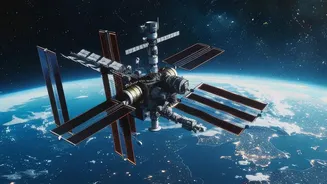
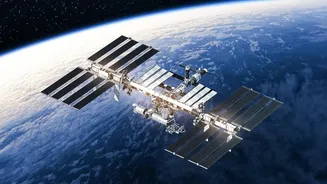
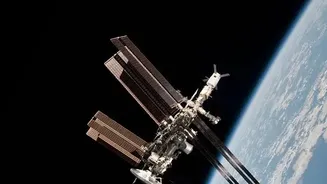
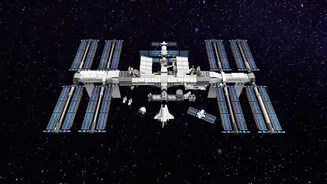
The International Space Station (ISS) is the largest man-made object in orbit, roughly the size of a football field. It serves as a home, laboratory, and observatory for an international crew of astronauts who conduct experiments in microgravity. Orbiting
Earth every 90 minutes at a staggering speed of 28,000 kilometres per hour, the ISS completes about 16 orbits per day. This incredible outpost for humanity is visible from over 90% of the populated world, including cities and towns all across India. Spotting it is a surprisingly simple and profound experience, connecting us on the ground to the astronauts living and working in space.
Finding Your Personal Timetable
The ISS is constantly moving, so sighting times are specific to your exact location. The best way to get an accurate schedule is to use a dedicated tracking service. NASA’s official “Spot The Station” website is an excellent resource. You can visit the site and enter your city—be it Delhi, Mumbai, Bengaluru, or a smaller town—to get a list of upcoming viewing opportunities. You can also sign up for email or text message alerts that notify you when the station is flying over. Another highly regarded tool is the Heavens-Above website, which provides detailed 10-day predictions. For those who prefer apps, options like ISS Detector, Satellite Tracker, and Orbitrack offer real-time tracking, alerts, and even live sky views on your phone.
Decoding the Sighting Data
Once you get an alert, you'll see some technical terms. Don't be intimidated; they're easy to understand. 'Max Height' or 'Elevation' tells you how high the station will be in the sky, measured in degrees from the horizon (0°) to directly overhead (90°). A pass with a higher maximum elevation will be more prominent and easier to see. 'Appears' and 'Disappears' will list a direction, like 'WNW' (West-Northwest). This is the 'Azimuth', or compass direction, telling you where to look for the station to first become visible and where it will vanish. Finally, 'Magnitude' (Mag) indicates brightness. Just like in golf, a lower or negative number is better—meaning the pass will be brighter. For reference, Venus, one of the brightest objects in the sky, can have a magnitude of -4.5.
What to Look For
Forget what you know about planes. The ISS does not have blinking or flashing lights. Instead, it appears as a very bright, steady, white point of light moving smoothly and quickly across the night sky. It looks like a fast-moving star and will typically cross from one horizon to the other in about three to six minutes. You don’t need binoculars or a telescope; the ISS is one of the brightest objects in the night sky and is easily visible to the naked eye. The best viewing times are shortly after sunset or before sunrise. During these twilight hours, your patch of sky is dark, but the ISS is high enough to still be reflecting sunlight, which is what makes it shine.
Tips for a Perfect Sighting
To make the most of your skywatching moment, find a spot with a relatively clear view of the horizon, away from the direct glare of streetlights if possible. Head outside five minutes before the pass is scheduled to begin. This gives your eyes time to adjust to the darkness, making it much easier to spot the station as it appears. Avoid looking at your bright phone screen right before you look up. Once you know the 'appears' direction from your tracker app or website, face that way and be patient. The sight of this silent, brilliant light gliding across the starscape is a memorable experience that reminds us of the incredible human journey into space.