



More Than Just Standing
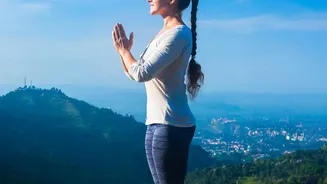
Mountain Pose, or Tadasana, is the blueprint for all other standing poses in yoga. It teaches the fundamentals of alignment and body awareness that you carry into every other posture, from Warrior poses to balancing acts. While it appears static, Tadasana is a dynamic
pose that requires conscious muscle activation throughout the body. The goal is not to be rigid like a soldier but to find a state of active stillness, embodying the strength and stability of a mountain. This begins with your connection to the earth through your feet and travels up through the engagement of your legs. Proper practice strengthens the thighs, knees, and ankles while improving posture and balance.
The Anatomy of Leg Engagement
Activating the legs in Tadasana involves more than just tensing your muscles. It's about creating a balanced system of support. The primary muscles you'll focus on are the quadriceps (front of the thighs). A simple cue is to gently lift your kneecaps, which automatically engages the quads. This action creates stability in the knee joint and is crucial for preventing hyperextension, especially for those with more flexible joints. Beyond the quads, you'll also engage the inner thigh muscles (adductors) and outer hip muscles (abductors) to keep your knees aligned over your ankles and prevent them from collapsing inward. This creates a chain of stability that runs from your feet all the way to your pelvis.
A Ground-Up Guide to Stability
Finding proper leg engagement is a process of building from a solid foundation. Start with your feet either together or hip-width apart and parallel. Distribute your weight evenly across all four corners of each foot: the mound of the big toe, the inner heel, the mound of the pinky toe, and the outer heel. From there, imagine lifting the inner arches of your feet. This subtle lift travels up the inner legs. Engage your thigh muscles to lift your kneecaps, but maintain a micro-bend in the knees to avoid locking them. Then, imagine gently rotating your thighs slightly inward. To help feel this rotation and engagement, you can practice squeezing a yoga block between your thighs. Finally, lengthen your tailbone down toward the floor to bring your pelvis into a neutral position, which supports the natural curve of your lower back.
Common Mistakes to Avoid
As you cultivate this awareness, watch out for common habits that undermine the pose. The most frequent error is locking the knees, which puts strain on the joints instead of using muscles for support. Always keep a slight softness or micro-bend in your knees. Another pitfall is uneven weight distribution, either leaning too far forward onto the toes or back onto the heels. Constantly check that your weight is balanced. Many people also tend to either over-tuck their pelvis, which flattens the lower back, or stick their tailbone out, creating an excessive arch. The goal is a neutral pelvis, which you can find by imagining it as a bowl of water that you don't want to spill forward or backward.
Benefits Beyond the Mat
Mastering leg engagement in Mountain Pose has benefits that extend far beyond your yoga practice. It teaches your body what healthy, optimal posture feels like, which can counteract the effects of slouching at a desk. By strengthening the muscles that support your joints, you improve your overall coordination and stability in everyday activities, from walking to lifting heavy objects. This mindful engagement can also help alleviate issues like back pain and sciatica by creating better alignment and decompressing nerves. Ultimately, the stability you build in your legs becomes the foundation for a calmer mind and a more centered presence, both on and off the mat.