





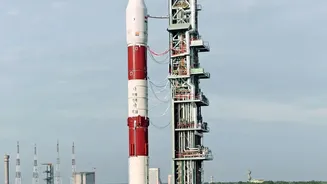

A New Space Age: From Government-Led to Government-Enabled
Historically, the Indian Space Research Organisation (ISRO) was the sole custodian of India's space ambitions. This model achieved incredible feats, but the global space economy, projected to grow significantly, demanded a new approach. Landmark policies,
including the Indian Space Policy 2023 and liberalised Foreign Direct Investment (FDI) norms, have changed the game. The government has created IN-SPACe (Indian National Space Promotion and Authorisation Centre) to act as a single-window agency, facilitating the entry of private companies into everything from satellite manufacturing to launch services. This shift doesn't diminish ISRO's role; instead, it allows the agency to focus on advanced research and development and complex exploratory missions like Gaganyaan, while private players drive commercialisation and build a robust domestic industry.
The Expanding Universe of Space Careers
When you think of a space job, you might picture a rocket scientist or an astronaut. That picture is now incomplete. The modern space economy is vast, encompassing roles that are far more diverse. The real growth is in satellite manufacturing, ground systems operations, and especially, the application of space-based data. Companies are hiring remote sensing and GIS experts to analyse satellite imagery for agriculture, urban planning, and environmental management. Aerospace software engineers are in high demand to build the complex code that powers missions, from flight software to autonomous navigation systems. As the sector commercialises, new roles in space law, policy, and business development are emerging to manage contracts, ensure regulatory compliance, and secure international clients.
Meet the New Trailblazers: India's Space-Tech Startups
The clearest sign of this new era is the boom in private space startups. As of 2026, India has over 400 space-tech startups registered with IN-SPACe, attracting significant venture capital. Companies like Skyroot Aerospace and Agnikul Cosmos are building their own launch vehicles to cater to the growing small satellite market. Skyroot became the first private Indian company to successfully reach space, a major milestone for the commercial sector. Meanwhile, companies like Pixxel are deploying constellations of hyperspectral imaging satellites, providing data for everything from agriculture to climate monitoring. Other startups such as Dhruva Space and Bellatrix Aerospace focus on satellite platforms and in-space propulsion. These companies are not just concepts; they are actively hiring, raising funds, and launching real missions.
The Skills You'll Need for Liftoff
The demand for talent is set to explode, with projections suggesting the creation of over 200,000 new jobs in the coming years. To secure a place in this industry, a specific skill set is becoming essential. A B.Tech in disciplines like Aerospace, Mechanical, Electronics, or Computer Science remains a strong foundation. However, cross-disciplinary skills are now critical. Proficiency in programming languages like Python, C++, and MATLAB is highly sought after for roles in software and data analysis. Expertise in AI and machine learning is crucial for processing the vast amounts of data generated by satellites. Other key areas include robotics, materials science, avionics, and systems engineering. Importantly, practical experience through internships, university projects like CubeSats, and robotics competitions can significantly boost your prospects.
How to Prepare for Your Future in Space
Aspiring professionals should start by building a strong academic foundation. While the Indian Institute of Space Science and Technology (IIST) offers a direct path into ISRO, graduates from top engineering colleges like the IITs and NITs are aggressively recruited by private firms. Beyond an undergraduate degree, consider specialisations through M.Tech or PhD programs in fields like aerodynamics, remote sensing, or avionics. But technical skills are only half the story. Develop strong analytical and problem-solving abilities, as well as teamwork and communication skills, which are vital in the collaborative environment of space missions. Follow the industry closely by tracking the progress of companies like Skyroot, Pixxel, and Agnikul. This is a field where staying informed about the latest technological advancements and mission milestones is part of the job.