



The Classic Tale of Two Objects
In the grand story of our solar system, asteroids and comets have long been cast in two distinct roles. Asteroids were seen as the stoic, rocky inhabitants of the inner solar system, mostly residing in the vast belt between Mars and Jupiter. They were formed
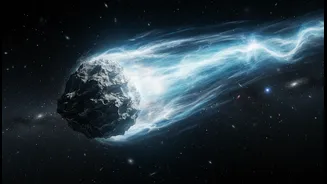
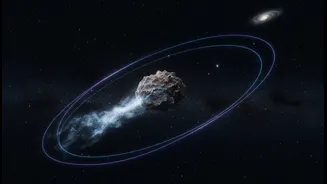
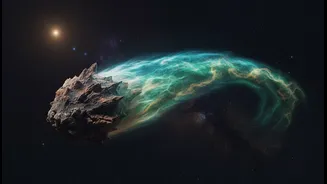
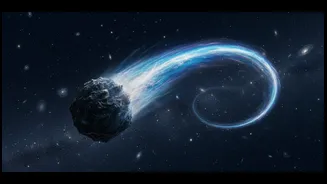
closer to the Sun, where it was too warm for ice to remain solid. Think of them as cosmic potatoes—lumps of rock and metal, largely unchanging as they follow their relatively circular orbits. Comets, on the other hand, were the dramatic visitors from far away. Originating in the icy depths of the Kuiper Belt beyond Neptune or the even more distant Oort Cloud, they are essentially dirty snowballs made of ice, dust, and rock. When their highly elliptical orbits bring them close to the Sun, the heat causes their ice to vaporise, creating a glowing atmosphere called a coma and often a spectacular tail that can stretch for millions of kilometres. For decades, this classification worked well; if it was rocky and stayed put, it was an asteroid. If it was icy and had a tail, it was a comet.
When Worlds Defy Their Labels
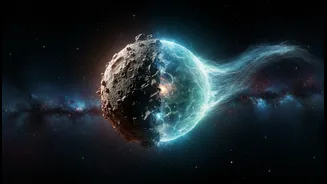
The universe, however, rarely fits into perfectly neat boxes. In recent years, astronomers have started discovering objects that refuse to play by the old rules. They've found bodies in the heart of the asteroid belt that suddenly sprout comet-like tails. These objects, now dubbed "active asteroids" or "main-belt comets," have asteroid-like orbits but exhibit comet-like behaviour. The first of these, an object named 7968 Elst-Pizarro, was seen with a tail in 1996, despite orbiting squarely within the asteroid belt. At first, astronomers thought these might be rare flukes, perhaps the result of a recent collision kicking up dust. But as more were found, it became clear something more fundamental was at play. The activity on some of these objects, like 133P/Elst-Pizarro, is recurrent, appearing each time they get closest to the sun, suggesting the sublimation of buried ice is the cause—just like a comet. These discoveries challenge our core assumptions. How can icy bodies exist for billions of years in the relatively warm inner solar system? These hybrid objects prove that the line between a rocky asteroid and an icy comet is far more of a spectrum than a sharp divide.
A Spectrum of Possibilities
This identity crisis has led astronomers to call for a more flexible and useful classification system. The simple binary of 'asteroid' or 'comet' is no longer sufficient. Since the International Astronomical Union's 2006 redefinition of celestial bodies, many of these objects now fall under the broad umbrella of "Small Solar System Bodies" (SSSBs), a category for anything that isn't a planet, dwarf planet, or moon. But even this is too broad for detailed scientific work. The emerging view is to classify objects based on a continuum of properties. Instead of asking "Is it an asteroid or a comet?", scientists are now asking "How active is it?" and "What is its orbit like?". This creates a more nuanced, two-dimensional framework. An object could be dynamically an asteroid (with a stable, circular orbit in the main belt) but physically a comet (showing sublimation-driven activity). This approach acknowledges that an object's nature isn't fixed. A comet could eventually exhaust all its ice and become a dormant, asteroid-like body. This flexible view helps to categorise the less than 40 known active asteroids and make sense of their diverse causes of activity, which can range from ice sublimation to impacts or even rapid rotation tearing them apart.
Why This Cosmic Rebranding Matters
This might seem like an academic debate over labels, but the implications are profound. Understanding these hybrid objects is crucial for piecing together the history of our solar system. For example, main-belt comets could be a key to understanding how Earth got its water. The chemical signature of water in Earth's oceans doesn't perfectly match that of traditional comets from the outer solar system, but it might be a better match for these icy asteroids from closer to home. Correctly classifying these small worlds is also vital for planetary defence. Knowing an object's composition—whether it's a solid piece of rock or a loosely-packed pile of icy rubble—dramatically changes how we might approach deflecting it if it were on a collision course with Earth. Furthermore, new powerful observatories like the Vera C. Rubin Observatory, expected to come online in 2025, will discover millions of new asteroids, increasing the known population tenfold. Having a robust and nuanced classification system will be essential to make sense of this coming flood of data and to identify the most scientifically interesting—or potentially hazardous—objects quickly and efficiently.