



What Makes a Planet 'Superhabitable'?
The idea of a superhabitable planet challenges our geocentric bias — the assumption that Earth is the template for a perfect, life-bearing world. First proposed in 2014 by scientists René Heller and John Armstrong, the concept isn't about finding a nice
place for humans to visit. Instead, it's a world where the conditions could support a richer, more abundant, and more diverse biosphere than Earth's. The search for these worlds forces us to look beyond the 'Goldilocks Zone' and consider a checklist of traits that could make a planet more biologically productive over billions of years. As astrobiologist Dirk Schulze-Makuch explains, we risk overlooking planets even more well-suited for life if we only hunt for a second Earth.
The Ideal Host Star
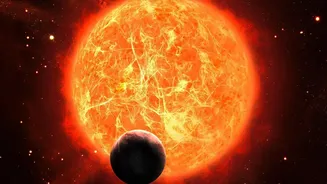
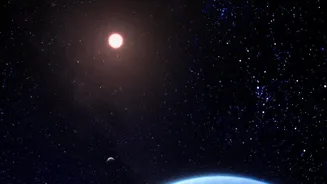
Our sun, a G-type star, has a lifespan of about 10 billion years. It took nearly 4 billion years for complex life to appear on Earth, meaning we are on a bit of a cosmic clock. Superhabitable planets would likely orbit K-dwarf stars, sometimes called orange dwarfs. These stars are cooler, smaller, and less luminous than our sun, but they are the true 'Goldilocks stars' for two key reasons. First, they have incredibly long lifespans, lasting from 15 to 45 billion years, giving complex life much more time to evolve. Second, while more active than our sun, they are far less violent than the most common stars, M-dwarfs, which are known for powerful flares that could strip a planet's atmosphere and bathe its surface in harmful radiation.
Bigger, Warmer, and Wetter
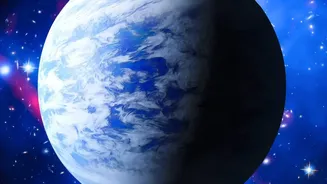
While it sounds counterintuitive, a planet slightly bigger than our own could be more life-friendly. A world up to twice Earth's mass and about 20% to 30% larger by volume would have stronger gravity. This could help it retain a thicker atmosphere, providing better shielding from cosmic rays and acting as an insulating blanket to keep temperatures stable. A slightly higher average temperature, around 25°C, could also boost biodiversity, much like Earth's tropical rainforests are bursting with life. More surface water, distributed across shallow oceans rather than deep, vast ones, could also encourage greater biodiversity by allowing light to penetrate to the seafloor across larger areas.
The Importance of Age and Geology
A truly superhabitable world would be older than Earth, perhaps between 5 to 8 billion years old, hitting the sweet spot for sustained habitability. It also needs the right geological engine. Greater mass can help a planet retain its internal heat, fueling long-term plate tectonics and volcanism. These processes are vital for recycling elements, regulating the atmosphere through the carbon cycle, and creating diverse habitats. A larger iron core could also generate a stronger magnetic field, another critical feature. This magnetic shield would offer superior protection against dangerous cosmic radiation and stellar winds, preserving both the atmosphere and any life that emerges on the surface.
Redefining the Search for Life
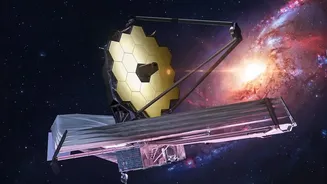
So, what does this all mean for finding aliens? Focusing on superhabitable worlds is a strategic shift. Instead of just looking for signs of any life, it prioritizes planets where life could be widespread, complex, and detectable. A planet with higher biodiversity might produce more definitive biosignatures for telescopes like the James Webb Space Telescope to find. In 2020, a study led by Schulze-Makuch identified 24 top contenders for superhabitable planets from the thousands of known exoplanets. While they are all over 100 light-years away, these worlds represent prime targets for future observation. This approach moves us from a search for another Earth to a search for a world that is empirically better for life as a whole, increasing our odds of finally answering the question: are we alone?