


What Exactly Was Found?
In astronomy, 'organic' simply means a molecule is carbon-based. While it doesn't mean aliens have been found, it's the next best thing. Using the powerful James Webb Space Telescope (JWST), astronomers have detected a surprising variety of these molecules
frozen in the ices surrounding young, developing stars, a place known as a protoplanetary disk. Discoveries include familiar compounds like methanol and ethanol (types of alcohol), acetic acid (the stuff in vinegar), and even more complex ones like methyl cyanide and pyrene. Previously, detecting these complex organic molecules (COMs) in their early, frozen state was incredibly difficult. These findings prove that the raw ingredients for more complex chemistry are abundant in the very places where new worlds are assembled.
A Nursery for New Worlds
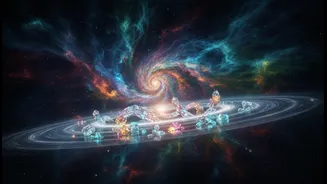
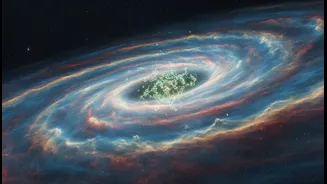
The discovery was made in what scientists call a protoplanetary disk — a vast, rotating ring of gas and dust that surrounds a young star. Think of it as a cosmic construction site. Over millions of years, the dust and ice in this disk clump together, forming pebbles, then boulders, and eventually entire planets, moons, and comets. Finding these organic molecules here is crucial. It means that as planets form, they are incorporating these vital, carbon-rich compounds from the very beginning. This is much like mixing all the dry ingredients for a cake before you even start baking. The materials needed for life's recipe are being included at step one.
Rewriting the Planetary Playbook
For a long time, a key question was whether these complex molecules could survive the chaotic and high-energy environment of a forming star system. An alternative theory was that simple molecules were delivered to young planets and only later, under the right conditions, formed more complex structures. These new observations suggest that the building blocks of life don't need to be made on a planet; they can be inherited directly from the interstellar cloud that gave birth to the star system. Recent observations by ALMA (Atacama Large Millimeter/submillimeter Array) have shown these molecules are far more abundant in protoplanetary disks than in the general interstellar clouds, suggesting disks are highly efficient factories for creating them. It's a significant shift in thinking that simplifies the pathway to creating a habitable world.
A Cosmic Delivery System
So, how do these ingredients get from the cosmic dust cloud to a planet's surface? The leading theory involves comets and asteroids. These icy bodies are pristine leftovers from the early days of a solar system. As they formed, they trapped the water ice and organic molecules from the protoplanetary disk. Later, during a period of heavy bombardment like the one our own early Earth experienced, these comets and asteroids would have crashed into the young planets, delivering their precious cargo of water and organic compounds. This cosmic delivery service could have kick-started the prebiotic chemistry that eventually led to life. The discovery of sugars like erythrulose in molecular clouds further supports this idea, showing that even more complex ingredients could have been delivered.
The Next Chapter in Cosmic Chemistry
This is just the beginning. With the unprecedented power of the JWST, scientists can now peer into these stellar nurseries with stunning clarity. They are not just identifying molecules but mapping their locations within the disks, revealing how different ingredients are distributed in the zones where different types of planets might form. Future observations will aim to find even more complex molecules, such as amino acids, the direct building blocks of proteins. While not yet detected in these disks, their precursors are clearly abundant. Each new discovery helps piece together the incredible journey from stardust to the complex chemistry that makes life possible.