
The Goldilocks Zone Isn't 'Just Right'
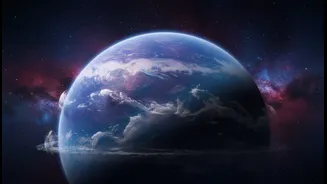
Scientists get excited when they find a planet in the habitable zone, often called the 'Goldilocks zone'. This is the orbital region around a star where conditions are not too hot and not too cold for liquid water to exist on a planet's surface. Since
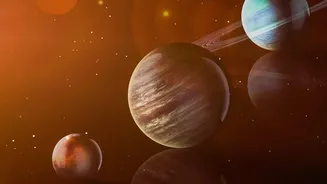
all life as we know it requires liquid water, this has long been the starting point in the search for life beyond Earth. However, this definition is a broad hypothesis. A planet's position doesn't guarantee habitability. The temperature of a world is also massively influenced by its atmosphere, reflectivity, and other factors. In our own solar system, both Venus and Mars sit near the edges of the habitable zone, yet they are poster children for inhospitable environments—one a scorching pressure cooker, the other a frozen, irradiated desert. Location is just an address; the atmosphere tells us what's actually going on inside the house.
An Atmosphere Makes the Planet
An atmosphere is what separates a sterile rock from a potentially dynamic world. It regulates temperature through the greenhouse effect, provides a shield from harmful cosmic radiation, and allows for the chemistry that life requires. Without its atmosphere, Earth's average surface temperature would plummet to well below freezing. Therefore, simply finding a planet in the right spot is not enough. The crucial next step is to determine if it even has an atmosphere and, if so, what it's made of. A planet's ability to hold onto its atmosphere is vital. A world that is too small, for instance, won't have enough gravity to prevent its atmosphere from escaping into space over billions of years. This is why the focus of modern exoplanet science has shifted from just finding planets to deciphering their skies.
Sniffing for Signs of Life
When astronomers study an exoplanet's atmosphere, they are hunting for 'biosignatures'. These are gases or combinations of gases that could indicate the presence of biological processes. On Earth, life constantly pumps gases like oxygen, methane, and dimethyl sulfide (DMS) into the atmosphere. Finding a gas like oxygen on its own might not be a sure sign—it could be produced by non-biological processes. But finding it in combination with a gas like methane, which it would normally react with and destroy, suggests something is constantly replenishing them both. This is where the work gets complex. Scientists must rule out all possible geological or photochemical ways a gas could be produced before they can even begin to suggest a biological origin. It's a painstaking process of elimination.
The James Webb Telescope: Our Atmospheric Detective
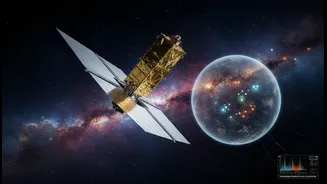
This new era of atmospheric investigation is powered by tools like the James Webb Space Telescope (JWST). JWST is an infrared powerhouse, capable of analyzing the light that filters through an exoplanet's atmosphere as it passes in front of its star. As the starlight passes through, different molecules in the atmosphere absorb specific wavelengths of light, leaving a unique chemical fingerprint. By analyzing this 'transmission spectrum', scientists can identify the molecules present, including water vapor, methane, carbon dioxide, and other potential biosignatures. It's an incredibly delicate process, as JWST sees these distant worlds only as single pixels of light, but the information encoded in that light is revolutionary.
The Case of K2-18 b
A compelling example of this science in action is the exoplanet K2-18 b, located 124 light-years away. This 'sub-Neptune' planet orbits within its star's habitable zone. Using JWST, astronomers detected carbon-bearing molecules, including methane and carbon dioxide, in its atmosphere. The data also supported the idea that it could be a 'Hycean' world—a planet with a liquid water ocean under a hydrogen-rich atmosphere. Most intriguingly, initial observations showed a tentative hint of dimethyl sulfide (DMS), a molecule that, on Earth, is only produced by life, primarily marine microbes. However, follow-up analyses have tempered this excitement, showing the DMS signal is not conclusive and that non-biological processes could potentially create it. The K2-18 b story isn't a discovery of alien life, but a perfect illustration of the scientific process: a tantalizing hint followed by rigorous verification.