


The Constant Drag of Low Orbit
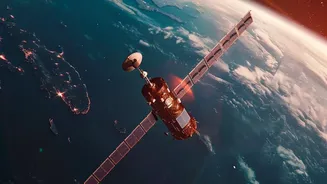
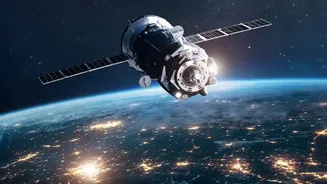
Contrary to the popular image of space as a perfect vacuum, the upper reaches of Earth's atmosphere don't just stop. In very low-Earth orbit (VLEO), altitudes between 150 to 400 kilometres, there are still enough air molecules to create significant drag
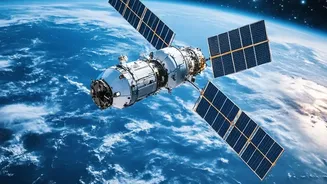
on a satellite moving at nearly 8 kilometres per second. This drag acts like a brake, slowing the spacecraft and causing its orbit to decay. To counteract this, satellites must periodically fire thrusters to boost themselves back up. This requires carrying a finite amount of propellant, like xenon gas. Once that propellant runs out, the satellite's mission is over, and it eventually burns up upon re-entry. This fuel limit is the single biggest factor determining the operational lifespan of many valuable Earth-observation and communication satellites.
A Revolutionary Idea: Inhaling the Atmosphere
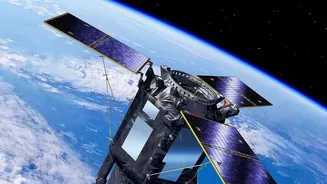
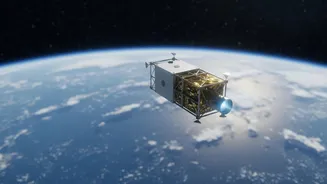
What if, instead of fighting the atmosphere, a satellite could use it? That's the core concept behind air-breathing electric propulsion (ABEP), sometimes called ram-EP. First proposed decades ago, the technology has seen significant advancements recently, with successful ground tests by groups like the European Space Agency (ESA). The idea is brilliantly simple: turn the very atmospheric particles that cause drag into a source of propellant. Instead of carrying heavy tanks of fuel from Earth, an ABEP-equipped satellite scoops up the residual air in its path and uses it to generate thrust, effectively making its fuel source limitless as long as it has power.
How It Breathes in Space
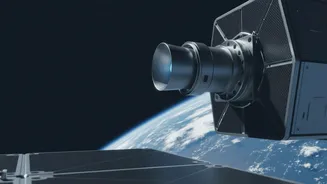
The process works through two key components: a specialized intake and an electric thruster. First, a carefully designed collector funnels in the scarce atmospheric molecules—mostly oxygen and nitrogen—as the satellite speeds through orbit. Instead of just bouncing off, the molecules are captured and compressed. Next, these captured particles are fed into an electric propulsion system. Using power from solar panels, the system gives the air molecules an electric charge, turning them into a plasma. This plasma is then accelerated by a magnetic field and ejected out the back at high velocity. This expulsion creates a small but continuous thrust, precisely enough to counteract the atmospheric drag that would otherwise pull the satellite down. It’s an elegant solution that transforms a problem into the solution itself.
A New Era for Satellites
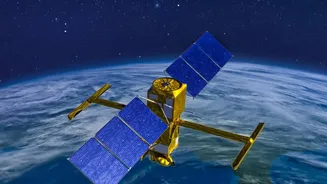
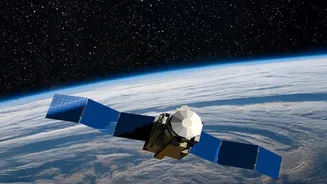
The implications of this technology are enormous. By removing propellant as a limiting factor, ABEP could enable satellites to operate in VLEO for years on end—as long as their electronic components continue to function. This opens the door to entirely new classes of missions. Earth observation satellites could fly lower, providing much higher-resolution imagery for everything from climate monitoring to agriculture. Communication satellite constellations could offer lower latency connections. Furthermore, it promotes space sustainability. Since these satellites naturally de-orbit quickly without thrust, they are less likely to become long-term space debris once their mission is complete. This makes VLEO an inherently cleaner and safer orbital environment.
Challenges and the Path Forward
While successful ground tests have proven the concept is no longer just a theory, there are still hurdles to overcome before we see fleets of air-breathing satellites. The technology provides very low thrust, making it suitable only for drag compensation, not for large orbital maneuvers. The systems must also be incredibly durable to withstand the corrosive effects of atomic oxygen in the upper atmosphere. Researchers are focused on optimizing the intake designs and improving the efficiency of the electric thrusters to handle the varying atmospheric densities. Projects funded by the ESA and other research groups are now moving toward developing hardware and integrated systems ready for space-based demonstration. This technology could even be adapted for other worlds with atmospheres, like Mars, enabling new kinds of long-duration exploratory missions.