




Looking for a new challenge to build serious shoulder and core strength without stressing your wrists? The dolphin push-up is a dynamic, powerful movement that combines the best of a plank and a pike to enhance stability and mobility.
What Exactly Is a Dolphin Push-Up?
The dolphin push-up
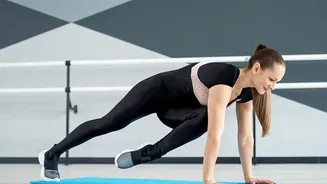
is a unique bodyweight exercise that merges yoga and calisthenics. Imagine a hybrid movement: it starts in a forearm plank, moves into a 'dolphin pose' (similar to a downward dog but on your forearms), and then glides forward into a challenging push-up motion. Unlike a traditional push-up that primarily targets the chest and triceps with wrist pressure, the dolphin push-up places a significant emphasis on the deltoids, upper back, and the entire core musculature. It is a test of strength, stability, and control, requiring you to move your body as a single, fluid unit. Because the movement is so focused on form, it is the perfect addition to a controlled session where quality of movement is prioritised over quantity of repetitions.
The Unique Benefits of Control
The primary benefit of the dolphin push-up is the development of robust shoulder strength and stability. It directly targets the deltoids through a wide range of motion, helping to build the muscles that protect this complex joint. Secondly, it is a phenomenal core exercise. To perform the movement correctly, your abdominals, obliques, and lower back must work constantly to prevent your hips from sagging or rising too high. This builds functional core strength that translates to better posture and performance in other lifts. It also promotes thoracic spine mobility, helping to counteract the stiffness that can come from sitting for long periods. Finally, because your weight is on your forearms, it is an excellent wrist-friendly alternative for those who find traditional push-ups or planks uncomfortable.
Your Step-by-Step Guide to Form
Proper execution is critical to reap the benefits and avoid injury. Follow these steps for a controlled and effective dolphin push_up:
1. Start in a forearm plank. Place your forearms on the floor, shoulder-width apart, with your palms flat or clasped. Your body should form a straight line from your head to your heels.
2. Engage your core. Before you move, brace your abdominal muscles as if you are about to be punched in the stomach. Keep this tension throughout the exercise.
3. Lift your hips. Press your forearms into the floor and walk your feet in slightly as you lift your hips up and back, forming an inverted 'V' shape. This is the dolphin pose.
4. Glide forward. From the dolphin pose, begin to lower your hips and shift your weight forward. Your head should travel past your hands as your shoulders move towards the floor.
5. Control the return. Push through your forearms and shoulders to press your body back up to the dolphin pose, lifting your hips high again. This completes one repetition.
Common Mistakes to Avoid
To ensure you are performing the exercise safely and effectively, watch out for these common errors. The most frequent mistake is letting the hips sag during the forward glide. This disengages the core and puts undue stress on the lower back. To fix this, maintain constant core tension. Another issue is using momentum instead of muscle. Avoid rushing the movement; each phase should be deliberate and controlled. Many people also fail to move through the full range of motion, either not lifting their hips high enough in the dolphin pose or not bringing their head far enough forward. Focus on achieving that full expression of the movement on every rep. Lastly, avoid shrugging your shoulders up towards your ears. Keep your shoulders packed down and away to properly engage the lats and protect your neck.
Integrating Dolphin Pushups
Dolphin pushups are demanding, so it is best to integrate them into your routine thoughtfully. For a controlled upperbody session, you might perform 3 to 4 sets of anywhere from 5 to 12 repetitions, depending on your strength level. Focus entirely on perfect form. They can serve as a primary shoulderstrengthening exercise or as a 'finisher' at the end of your workout to exhaust the core and shoulders. If you are new to the movement, you can start with a regression. Simply practice holding the dolphin pose or perform smaller movements, not going as far forward. As you get stronger, you can progress the exercise by slowing down the tempo, adding a pause at the lowest point, or even attempting it with one leg lifted off the ground for an extra stability challenge.