




A New Eye on the Cosmos
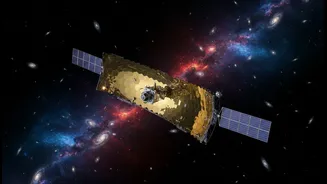
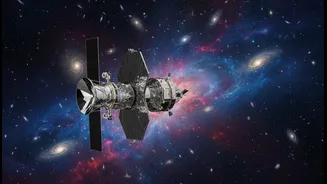
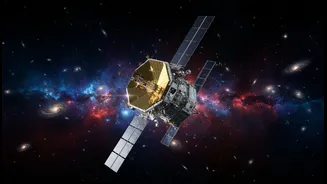
Scheduled for launch in August 2026, the Nancy Grace Roman Space Telescope represents the next generation of space observatories. Named after NASA's first chief of astronomy, the 'Mother of Hubble' Nancy Grace Roman, this telescope is designed not just
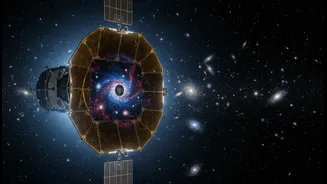
to peer at distant objects but to survey huge swathes of the sky. While it has a primary mirror the same size as the Hubble Space Telescope—2.4 meters in diameter—its power lies in its extraordinary field of view. Its main instrument, the Wide Field Instrument (WFI), is a 300.8-megapixel camera that will capture images with the same sharpness as Hubble but across a much, much larger area. This unique capability is what will allow it to conduct vast cosmic surveys, creating unprecedented maps of the universe.
The Power of a Panoramic View
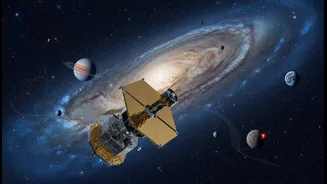
The key difference between Roman and its predecessors is scale. Roman’s field of view is over 100 times larger than Hubble’s primary infrared instrument. Imagine trying to photograph an entire city. Hubble would capture a single window in exquisite detail, while Roman could capture the entire city block in a single shot with similar clarity. For example, it took Hubble over 400 separate images to create its famous mosaic of the Andromeda galaxy; Roman could achieve a similar survey in just a few pointings. This panoramic capability is what transforms the telescope into a mapping machine. Instead of focusing on individual, pre-selected targets, Roman will systematically scan the sky, building a massive catalogue of billions of galaxies and stars. This approach is essential for studying the largest structures in the cosmos and finding rare, transient events like supernova explosions.
Hunting for Cosmic Mysteries
Roman has two primary scientific goals that depend on this mapping ability: understanding dark energy and completing a census of exoplanets. Dark energy is the mysterious force causing the expansion of the universe to accelerate, and Roman will tackle it by mapping the distribution of galaxies and observing distant supernovae over time. These large-scale structure maps will help scientists trace the history of cosmic expansion. For exoplanets, Roman will conduct a massive survey of the Milky Way's central bulge, using a technique called gravitational microlensing. This method is sensitive enough to find planets with masses even smaller than Earth. By repeatedly monitoring hundreds of millions of stars, the mission is expected to discover thousands of new worlds, providing a statistical treasure trove for understanding how common solar systems like our own really are.
A Deluge of Cosmic Data
Mapping the universe on this scale will generate an enormous amount of information. Over its five-year primary mission, Roman is expected to produce about 20 petabytes of data—a volume that dwarfs what Hubble and even the James Webb Space Telescope produce. This data deluge is both a challenge and a monumental opportunity. It will require new ways of processing and archiving astronomical information, making it all publicly available with no exclusive access period. This open-data policy means scientists from around the world can dive into Roman’s maps to make discoveries, potentially finding rare objects and phenomena that the primary surveys weren’t even designed to look for. It will effectively create a new, high-resolution digital map of the infrared sky for all to explore.