



Why Uzbekistan Is on the Rise
For years, Uzbekistan remained one of Central Asia's best-kept secrets. But a simplified e-visa process, growing word-of-mouth on social media, and a reputation for safety have put it firmly on the map for young, adventurous travelers. For Indian travelers,
the appeal is even stronger, with direct flights from Delhi and an easy online visa application that costs roughly ₹1,700. Unlike crowded European capitals, Uzbekistan offers a sense of genuine discovery. It's a place where you can explore UNESCO World Heritage sites without the overwhelming crowds, connect with a deeply hospitable culture, and experience history that feels alive and accessible.
Your Budget Will Thank You
The single biggest draw for budget-conscious travelers is the cost. Uzbekistan is remarkably affordable, with many sources suggesting a backpacker can comfortably get by on $30-50 per day. This budget covers a bed in a well-regarded hostel ($8-15), meals at local teahouses known as 'chaikhanas' ($3-5 per meal), and local transport. A filling plate of plov, the national dish of rice and meat, can cost as little as ₹150. Even a mid-range trip, with private rooms in charming boutique guesthouses and meals at nicer restaurants, often comes in under $100 per day, offering value that is hard to match in other popular destinations. For Indian travelers, the currency conversion is highly favourable, making your rupee go much further.
The Overland Adventure: Riding the Rails
A key part of the Uzbek experience is traveling between its great cities by land. The country boasts an impressive and modern train network that connects the main hubs of Tashkent, Samarkand, and Bukhara. The star of the show is the 'Afrosiyob', a Spanish-built high-speed train that makes the journey from the capital, Tashkent, to Samarkand in just over two hours. A ticket for this comfortable, efficient service can cost as little as $10-15. Booking is straightforward through the official railway website, which accepts international cards. These train journeys aren't just about getting from A to B; they offer a chance to see the country's diverse landscapes unfold and share a carriage with local families, adding another layer to the travel experience.
Samarkand: A City of Azure Domes
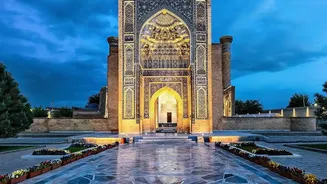
The main event for many is Samarkand, a city that has been a crossroads of world cultures for over two millennia. The heart of the city is the Registan, a public square framed by three magnificent, tile-covered madrasas (Islamic schools). Their scale and intricate blue tilework are breathtaking. Just a short walk away is the colossal Bibi-Khanym Mosque, built by the conqueror Timur to be the jewel of his empire. Another essential stop is the Shah-i-Zinda, an avenue of mausoleums decorated with some of the richest tilework in the Muslim world. These are not just sterile monuments; they are active sites of pilgrimage and wonder, where history feels tangible. Entrance fees to these major sites are modest, typically costing only $3-5 each.
Beyond the Monuments
While the architecture is the main draw, the soul of Samarkand is found in its living culture. Dive into the bustling Siyob Bazaar, located next to the Bibi-Khanym Mosque, where you can haggle for spices, nuts, and the city's famous bread. Younger travelers are also discovering the city's quieter corners, from the Ulugh Beg Observatory—the remains of a 15th-century astronomy center—to small, family-run guesthouses with tranquil courtyards. The local people are known for their warmth and hospitality, often eager to share a cup of tea or practice their English. It's these unscripted moments of connection that are making Samarkand a truly memorable destination for a generation seeking authenticity.