




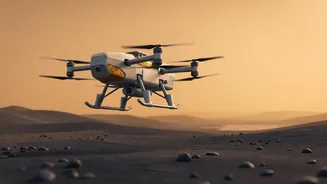
A Drone on a Distant World
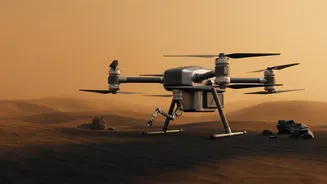
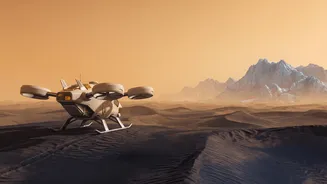
Scheduled to launch in July 2028, the Dragonfly rotorcraft will journey for six years to reach Titan, Saturn’s largest moon, arriving in 2034. Unlike Mars rovers that crawl across the surface, Dragonfly is an octocopter designed to fly. This is possible
thanks to Titan’s unique environment: its atmosphere is four times denser than Earth's, and its gravity is much lower, making flight relatively easy. Powered by a Multi-Mission Radioisotope Thermoelectric Generator (MMRTG)—the same type of nuclear power source used by the Curiosity and Perseverance rovers—Dragonfly will be able to hop from one scientifically interesting site to another, covering dozens of locations over its multi-year mission. This mobility allows it to explore diverse terrains, from organic sand dunes to impact craters, something a stationary lander or slow-moving rover could never achieve.
Titan: A Frozen Version of Primordial Earth
So, why Titan? This distant, frigid moon, where surface temperatures hover around -179°C, is considered by scientists to be a planetary-scale laboratory for prebiotic chemistry. It is the only other body in our solar system with a dense, nitrogen-rich atmosphere and a weather cycle involving clouds, rain, rivers, and lakes. But on Titan, it's not water that flows—it's liquid methane and ethane. Scientists believe Titan’s current atmosphere is remarkably similar to that of primordial Earth, before life emerged and filled our air with oxygen. Essentially, visiting Titan is like traveling back in time over 2.5 billion years to witness the conditions that may have sparked life on our own planet.
The Chemistry of Life's Origins
For billions of years, sunlight and radiation from Saturn’s magnetosphere have been breaking down the methane and nitrogen in Titan’s atmosphere, creating a complex soup of organic molecules. These molecules, heavier than the air, rain down onto the surface, blanketing it in a layer of organic material. These are the very kinds of carbon-based compounds that scientists theorize were the building blocks of life on early Earth. However, on our planet, billions of years of geology and biology have erased most of the direct evidence of this prebiotic chemistry. Titan, on the other hand, is a frozen, preserved record of these processes. Dragonfly's goal is not to find existing life, but to investigate how far this prebiotic chemistry has progressed and to search for key ingredients like amino acids, which could form when these organics interact with liquid water from impact melts or cryovolcanic flows.
What Dragonfly Will Search For
To conduct its investigation, Dragonfly is equipped with a sophisticated suite of scientific instruments. The Dragonfly Mass Spectrometer (DraMS) will analyze the chemical composition of surface samples to identify complex organic molecules. To collect these samples, the craft is fitted with a drill system called DrACO (Drill for Acquisition of Complex Organics), which can bore into the surface and transfer material to the spectrometer. Other instruments will measure the elemental composition of the ground, monitor weather and seismic activity (listening for "Titanquakes"), and take panoramic and aerial images with its camera suite, DragonCam. The mission plans to land first in the equatorial dune fields of Shangri-La before making its way to the Selk impact crater, a site where scientists believe the heat from an asteroid impact could have melted water ice, creating a temporary environment where complex organic molecules and liquid water could mix—a potential recipe for life.