

The Sun's Unseen Temper
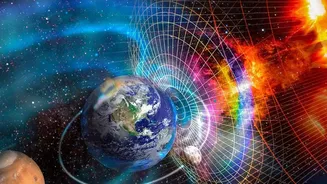
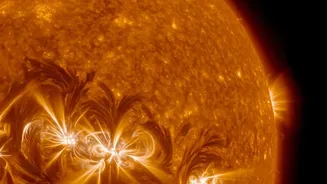
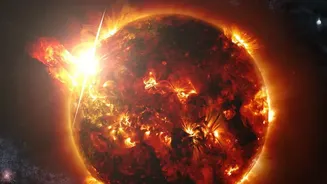
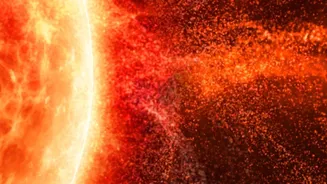
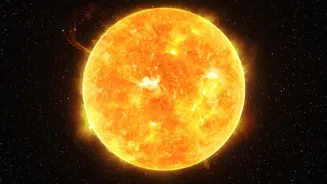
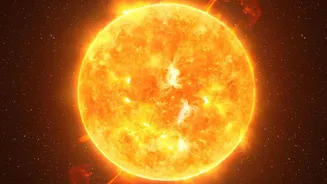
We depend on the Sun for life, but our star has a violent side. It periodically unleashes massive bursts of energy and magnetised plasma, known as coronal mass ejections (CMEs). While Earth's magnetic field protects us from most of this onslaught, a sufficiently
powerful, Earth-directed CME can trigger a geomagnetic storm. These storms induce powerful electrical currents on the ground that can overload power grids, leading to widespread blackouts like the one that struck Quebec in 1989. Beyond the power grid, these solar outbursts can disrupt high-frequency radio communications, cause errors in GPS navigation systems critical for aviation and logistics, and even damage the sensitive electronics of the very satellites our communication networks depend on.
An Artificial Eclipse in Space
To protect against this threat, we first need to see it coming. The problem is that CMEs originate in the Sun's outer atmosphere, the corona, which is a billion times fainter than the Sun's surface and normally invisible. This is where coronagraphs come in. A coronagraph is a special telescope that uses a disc to block the overwhelming glare of the Sun's main body, creating an artificial eclipse. This allows scientists to continuously monitor the faint corona and, crucially, spot a CME as it erupts and hurtles into space. By analysing a sequence of these images, forecasters can determine the size, speed, and direction of a CME.
From Solar Sentinels to Earthly Warnings
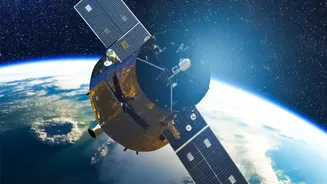
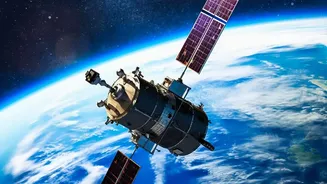
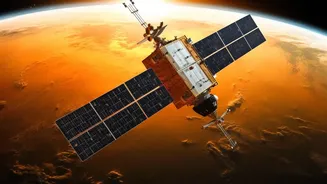
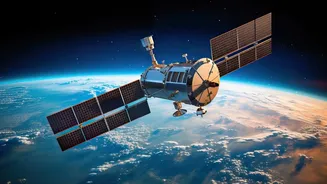
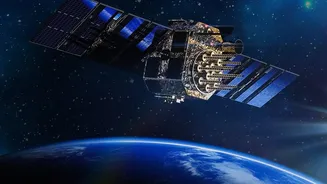
Coronagraphs are deployed on satellites strategically positioned in space to get an uninterrupted view. Many, like the joint ESA/NASA SOHO satellite and India's own Aditya-L1, are placed at Lagrange Point 1 (L1), a gravitationally stable spot 1.5 million kilometres from Earth along the Sun-Earth line. This vantage point gives them a constant view of the Sun and allows them to see a CME leaving the Sun well before it reaches us. Newer instruments, like NOAA's CCOR-1 on the GOES-19 satellite, provide even faster updates, delivering images every 15 minutes. This data is fed into predictive models which can forecast the arrival time and potential intensity of a geomagnetic storm, providing a crucial lead time of one to three days.
How an Early Warning Saves the Grid
A few days' warning might not seem like much, but for infrastructure operators, it is invaluable. Power grid operators can take protective measures like reducing the load on the system, postponing maintenance, and bringing extra generation capacity online to ensure grid stability. Satellite operators can put their spacecraft into a protective safe mode or adjust orbits to reduce drag from the temporarily expanding atmosphere. Airlines can reroute flights away from polar regions where the effects on communication and navigation are strongest. In essence, the forecast allows industries to brace for impact, turning a potential catastrophe that could cost trillions of dollars into a manageable event.
India's Eye on the Sun
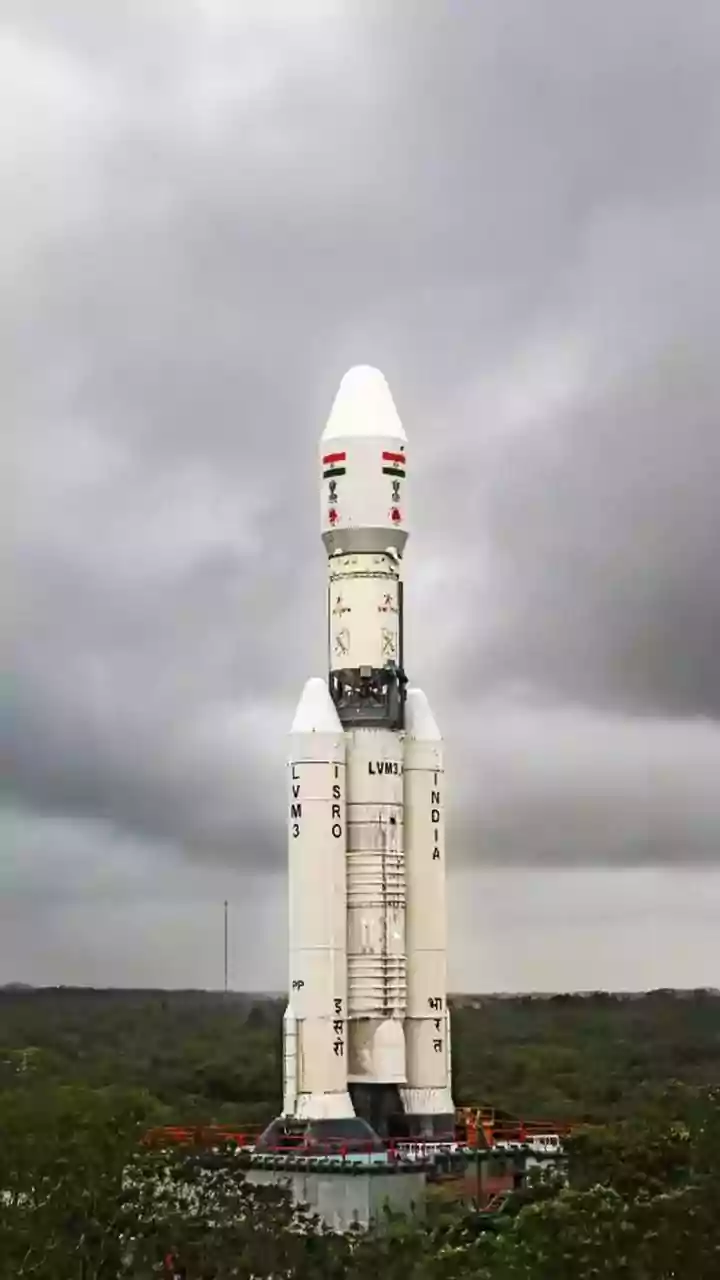
India has firmly established itself as a key player in this global effort with the Aditya-L1 mission, launched by ISRO in September 2023. Its primary instrument, the Visible Emission Line Coronagraph (VELC), is designed specifically to study CMEs, providing crucial data on solar activity. By contributing its own observations from the L1 point, Aditya-L1 enhances the global network of solar sentinels, improving the accuracy and reliability of space weather forecasts for everyone. This capability is vital for a nation as rapidly digitising as India, ensuring the resilience of its growing technological infrastructure.