






An Object of Extremes
So, what exactly is a neutron star? It’s the cosmic leftover from the death of a massive star. When a star between about 10 and 25 times the mass of our sun runs out of fuel, it collapses under its own gravity and then explodes in a spectacular supernova.
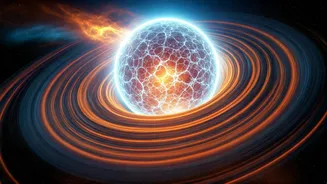
While the outer layers are blasted into space, the star's core is crushed into an object of almost unimaginable density. Protons and electrons are squeezed together so violently that they merge to form neutrons, hence the name. The result is a sphere roughly 12 miles in diameter that contains more mass than our sun. A single teaspoon of neutron star material would weigh about as much as every car in the United States combined—billions of tons. It’s an object so dense that it pushes the very laws of physics to their limits.
The Cosmic Ice Skater
The headline's claim of a star spinning 600 times is actually a dramatic understatement of the timescale involved. The fastest of these objects, called millisecond pulsars, don’t spin 600 times a week—they can spin over 600 times *per second*. To understand how this is possible, picture an ice skater spinning with her arms outstretched. As she pulls her arms in, her spin gets much faster. This is a physics principle called the conservation of angular momentum. A neutron star is the ultimate cosmic ice skater. It starts as a huge, relatively slow-spinning star. When its massive core collapses from hundreds of thousands of miles across down to a mere dozen, its rotational speed increases exponentially. The original slow rotation of the star is 'conserved' and amplified in the tiny, dense object left behind, whipping it into a frenzy of hundreds of revolutions every second.
A Lighthouse in the Dark
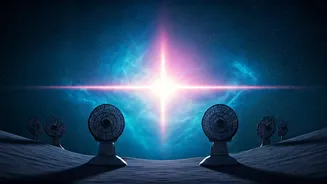
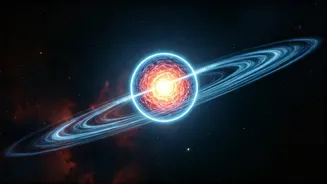
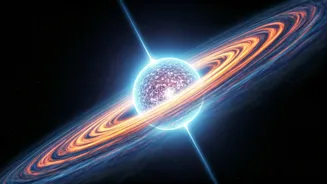
When we say telescopes “see” these stars, it’s not with visible light in the way you might imagine. Because of their intense magnetic fields, which are trillions of times stronger than Earth's, neutron stars often shoot out powerful beams of radiation (like radio waves or X-rays) from their magnetic poles. These poles rarely align perfectly with the star’s axis of rotation. The result is a cosmic lighthouse effect: as the star spins, the beams of radiation sweep across the universe. If one of these beams happens to sweep past Earth, our high-tech radio telescopes detect a regular pulse of energy. The timing of these pulses is incredibly precise, ticking with a regularity that rivals even our best atomic clocks. This is why these spinning neutron stars are also known as pulsars—they appear to pulse on and off as their beam flashes past our line of sight.
Why We Study These Spinners
Studying something so distant and bizarre might seem purely academic, but neutron stars are invaluable natural laboratories. They allow scientists to study the behavior of matter under conditions of pressure and density that are impossible to create on Earth. The intense gravity they produce warps spacetime around them, providing a perfect testing ground for Einstein's theory of general relativity. The incredible precision of their pulses also allows astronomers to detect the faint ripples in spacetime known as gravitational waves. By timing an array of pulsars across the galaxy, scientists can search for subtle disturbances caused by the merging of supermassive black holes. In essence, these tiny, fast-spinning stellar corpses are some of the most useful tools we have for understanding the fundamental workings of the cosmos.