

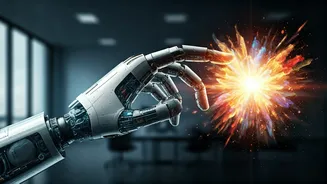



The Great Skill Reset
For decades, professional value was often tied to efficiency, specialized knowledge, and the ability to execute repetitive tasks flawlessly. But a massive shift is underway. With the rise of sophisticated AI and automation, tasks that are predictable
and rule-based are increasingly being handled by machines. This isn't science fiction; it's already happening in fields from data entry to customer service and even some aspects of coding. A recent LinkedIn report highlights that India is experiencing a fundamental skills reset, with projections showing that 64% of skills used in most jobs could change by 2030. This automation of routine work doesn't mean human jobs will disappear. Instead, it elevates the importance of skills that machines can't easily replicate, such as emotional intelligence, complex problem-solving, and, most importantly, creative thinking.
Redefining Creativity at Work
When we talk about creativity in a professional context, it’s not just about being artistic or working in design. Workplace creativity is the ability to look at a problem or a task in a new way and generate novel solutions. It’s about connecting seemingly unrelated ideas, asking “what if?” questions, and challenging assumptions to drive innovation. In India, this shift is already visible. According to research, creativity and innovation are among the top five fastest-growing skills that companies are hiring for. This demand isn't limited to traditional creative fields like marketing; it's now essential in IT, finance, education, and business development. As one Adobe study noted, creative work in India is increasingly happening outside of specialist roles, with a large portion of 'creators' coming from technical and IT backgrounds.
The Human-AI Partnership
The future of work isn’t a battle of humans versus AI, but rather a collaboration. Think of AI as a powerful tool that can handle the grunt work—analysing vast datasets, generating first drafts, or automating administrative tasks. This frees up human professionals to focus on higher-value work that requires judgment, strategic thinking, and original ideas. For example, a marketing manager might use AI to analyse consumer trends, but it’s the human who will devise a truly original and emotionally resonant campaign strategy. A developer might use AI to write boilerplate code, allowing them to spend more time on creative problem-solving and designing a better user experience. This partnership model, where humans guide and collaborate with AI, is where creativity becomes a massive advantage. Those who can leverage AI to augment their own creative potential will be the most sought-after professionals.
How to Build Your Creative Muscle
Creativity is not an innate talent reserved for a select few; it's a skill that can be developed with practice. One of the simplest ways to start is by cultivating curiosity. Actively seek out new information and perspectives, even from fields outside your own industry. Challenge your own assumptions by constantly asking questions. Instead of accepting the status quo, ask why things are done a certain way and how they could be improved. Another practical technique is to make time for focused creative thinking. Try simple exercises like the “incomplete figure test,” where you turn a random scribble into a full drawing, or the “30 circles test,” where you see how many different objects you can draw from 30 blank circles in a minute. These exercises train your brain to find new patterns and think more flexibly, which can help you tackle work challenges with fresh eyes. Embracing small experiments and being willing to fail are also crucial components of the creative process.