



A Sweet Discovery in the Stars
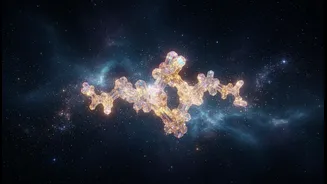
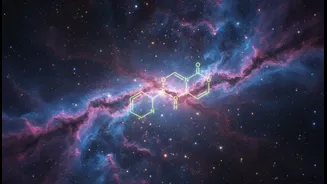
Scientists have detected several types of sugars in space, which is a remarkable achievement. One of the simplest is glycolaldehyde, which was found in a gas cloud near the centre of our galaxy. More significantly, researchers have found ribose, a much
more complex sugar, within meteorites that have crashed on Earth. Ribose is a crucial component of RNA (ribonucleic acid), a molecule essential for carrying genetic instructions in all known living organisms. These discoveries were made by analysing the chemical composition of powdered meteorite samples and by detecting the unique radio frequencies emitted by molecules in interstellar clouds. Finding these organic molecules confirms that some of the basic ingredients for life can form naturally in space.
Ingredients, Not the Finished Cake
So why isn't this proof of aliens? Think of it like baking. Finding flour, sugar, and eggs in a kitchen shows that you have the potential to make a cake. It does not, however, mean a cake already exists. The discovery of space sugars is similar; we've found some of life's raw ingredients, but not life itself. Scientists distinguish between prebiotic chemistry—the chemical processes that precede life—and biology. Finding ribose and other sugars is a huge win for understanding prebiotic chemistry. It suggests that the building blocks of life are not unique to Earth and could be widespread throughout the universe.
The Abiogenesis Hypothesis
This leads to a key scientific theory called abiogenesis. Abiogenesis is the natural process by which life arises from non-living matter. The theory suggests that on a young, primordial Earth, simple organic molecules combined over millions of years to form more complex structures, eventually leading to the first self-replicating cells. The discovery of space sugars strongly supports a version of this idea known as pseudo-panspermia, which proposes that these essential building blocks didn't have to form on Earth. Instead, they could have been delivered to our planet by meteorites and comets during a period of intense bombardment billions of years ago, effectively 'seeding' the planet with the necessary ingredients.
From Chemistry to Biology
The leap from a collection of molecules like sugars, amino acids, and phosphates to a living, self-replicating organism is enormous and one of the biggest unsolved mysteries in science. Life as we know it requires these building blocks to assemble in incredibly specific ways to form functional machinery like RNA and DNA. It also needs a way to protect itself from its environment (a cell membrane) and a method to harness energy to fuel its processes. Finding a sugar molecule is just the first, albeit very important, step on a very long and complex journey from simple chemistry to complex biology.
What Would Proof Look Like?
If space sugar isn't the smoking gun, what are scientists looking for? The ultimate proof of extraterrestrial life would be the detection of 'biosignatures'—complex substances, patterns, or objects whose origin can only be explained by life. This could include complex organic molecules arranged in a way that suggests biology, gases in a planet's atmosphere that are out of chemical equilibrium (like large amounts of oxygen and methane together), or, of course, a direct signal from an intelligent civilisation. Finding these basic ingredients is a critical part of the search, helping astronomers to narrow down which planets and moons might be the most promising places to look for life itself.