



The Standard Recipe for a Galaxy
Until very recently, the story of galaxy formation seemed well understood. The leading theory, known as the Lambda-Cold Dark Matter (ΛCDM) model, provided a powerful framework that explained much of what we see in the large-scale structure of the universe.
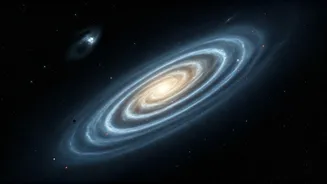
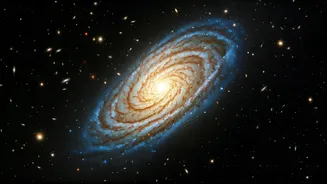
The idea was simple and elegant: galaxies grow hierarchically. After the Big Bang, tiny fluctuations in density caused invisible dark matter to clump together into vast, web-like structures called halos. These halos acted as cosmic seeds, their immense gravity pulling in clouds of hydrogen and helium gas. Over billions of years, these small, gassy fragments would merge, gradually building bigger and bigger galaxies. Think of it as cosmic Lego: starting with small pieces and slowly assembling them into grand structures like our own Milky Way. This model successfully predicted many observed features of the universe and became the bedrock of modern cosmology.
A Telescope Named Webb Changes Everything
Then came the James Webb Space Telescope (JWST). Launched in 2021, its powerful infrared instruments gave humanity an unprecedented ability to peer back in time, capturing light from the universe's infancy. Because light takes time to travel, looking at the most distant objects is like using a time machine to see the cosmos as it was just a few hundred million years after the Big Bang. Astronomers expected to see the first faint glimmers of baby galaxies—small, simple, and just beginning their long journey of growth, as predicted by the standard model. Instead, what Webb found sent shockwaves through the astronomical community. The telescope didn't just find a few oddities; it started finding a surprising number of galaxies in the early universe that were perplexingly bright and massive.
The 'Impossibly' Big Problem
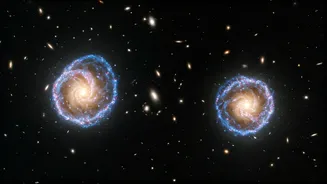
The core of the mystery lies in the discovery of what some have called 'universe breakers'—galaxies that are far too massive and mature for their age. According to the slow-and-steady growth model, there simply shouldn't have been enough time for galaxies to accumulate so many stars and so much mass so early on. Finding a galaxy as massive as the Milky Way just 500-700 million years after the Big Bang is like finding a fully-grown adult in a nursery full of newborns. One particularly stunning example, JADES-GS-z14-0, was confirmed to exist just 290 million years after the Big Bang, yet it was already surprisingly large, bright, and chemically developed. These ancient giants challenge the fundamental timeline of cosmic evolution, forcing scientists to ask: how did the universe build things so big, so fast?
Rewriting the Cosmic Rulebook
This discrepancy doesn't mean the Big Bang is wrong, but it does suggest our understanding of what happened next is incomplete. The discovery of these massive early galaxies has opened a floodgate of new ideas and forced a re-evaluation of long-held assumptions. Perhaps the first stars were different, forming more efficiently or in dramatic bursts that made galaxies appear brighter and more massive than they truly are. Maybe the process of converting gas into stars was much more rapid in the dense environment of the early universe. Some theories even propose more radical solutions, questioning the nature of dark matter or suggesting the standard model of cosmology itself needs revision. What was once a settled picture has become a vibrant and sometimes contentious debate.
The Hunt for New Answers
For scientists, this 'mystery zone' is not a crisis but an exhilarating opportunity. Every new image from Webb provides more data points for a puzzle that is actively being solved. Some researchers are running new, more complex computer simulations to see if they can replicate this rapid early growth under different conditions. Others are exploring whether supermassive black holes, also found surprisingly early, could be playing a key role, either by making their host galaxies look brighter or by influencing their growth. The field has gone from having a single, dominant theory to having a wealth of new hypotheses to test. This is science in action—a process of discovery, questioning, and refinement, pushing us toward a deeper truth about our cosmic origins.