


The Cosmic Shadow Play
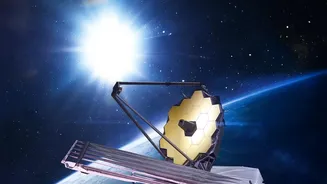
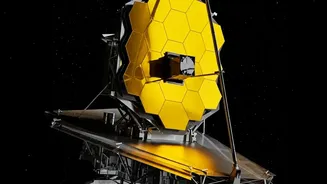
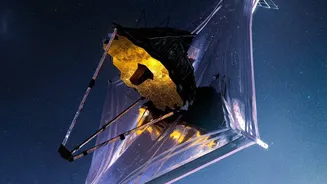
The primary method JWST uses is called transmission spectroscopy, and it relies on a specific alignment of a star, a planet, and the telescope. When an exoplanet passes in front of its host star from our perspective—an event called a 'transit'—a tiny
fraction of the starlight filters through the planet's atmosphere. This is the moment astronomers are waiting for. The telescope doesn't see the planet directly, but it can analyze the subtle changes in the starlight as it passes through this atmospheric fringe. Think of it like a cosmic shadow play, where the composition of the atmosphere dictates the nature of the shadow cast. This technique is how the planet is often first discovered and subsequently analyzed.
Reading a Chemical Fingerprint
Every chemical element and compound absorbs light at very specific wavelengths, or colors. Water is no different. As starlight streams through an exoplanet's atmosphere, any water vapour present will absorb its own unique set of light wavelengths. When JWST's highly sensitive instruments, like the Near-Infrared Spectrograph (NIRSpec) and the Near-Infrared Imager and Slitless Spectrograph (NIRISS), analyze the starlight that has passed through the atmosphere, they can see which 'colors' are missing. This pattern of missing light acts as a chemical fingerprint. If the specific signature of water is detected, scientists can confirm its presence. It's an incredibly precise measurement, often detecting subtle features that were invisible to previous telescopes.
A Case Study: The 'Hycean' World
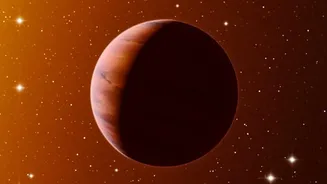
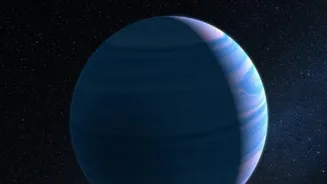
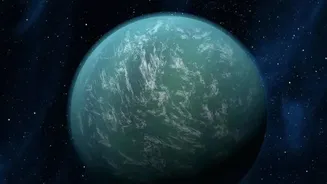
A compelling example of this technique in action is the observation of K2-18 b, an exoplanet located about 120 light-years from Earth. JWST's investigation revealed not just water vapour, but also carbon-bearing molecules like methane and carbon dioxide. The abundance of these molecules, combined with a shortage of ammonia, strongly supports the hypothesis that K2-18 b could be a 'Hycean' world—a planet with a hydrogen-rich atmosphere and a surface covered by a water ocean. These findings have made it one of the most intriguing targets in the search for habitable environments beyond our solar system. While this doesn't confirm life, detecting the building blocks and conditions for it is a monumental step forward.
Beyond Just Water
The telescope's power isn't limited to just finding water. The same spectroscopic method allows scientists to identify a whole range of molecules. For example, on K2-18 b, a possible detection was made of dimethyl sulfide (DMS), a molecule that, on Earth, is overwhelmingly produced by life, particularly marine phytoplankton. On other planets, like the ultra-hot gas giant WASP-18 b, JWST has detected water even under extreme temperatures of nearly 2,700 degrees Celsius, a testament to the telescope's extraordinary sensitivity. This ability to create a detailed chemical inventory for a distant world allows astronomers to understand its overall makeup, temperature, and even how and where it might have formed.
What It Means for the Search for Life
Each detection of water on an exoplanet, whether it's a gas giant or a potentially rocky world, is a crucial piece of the puzzle. It helps scientists understand how common water is throughout the galaxy and the different kinds of environments where it can exist. While JWST can't directly see alien life, it can identify worlds with the right ingredients and conditions to support it. By studying the atmospheres of planets in their stars' 'habitable zones'—the region where temperatures could allow for liquid water—the telescope is creating a roadmap for future exploration. It's transforming the search for life from a theoretical exercise into a data-driven science, narrowing down the most promising candidates for closer inspection.