






The Universe's Coolest Experiment
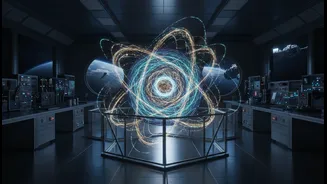
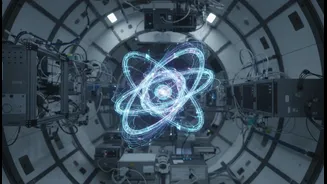
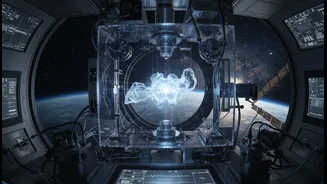
The Cold Atom Laboratory, or CAL, is a one-of-a-kind physics facility that launched to the International Space Station in 2018. Its mission is to study the strange and wonderful world of quantum mechanics by chilling atoms to temperatures just a fraction
of a degree above absolute zero—the coldest temperature theoretically possible. Operated remotely from Earth, the lab uses a complex system of lasers and magnetic fields to slow down clouds of atoms like rubidium and potassium until they are almost motionless. Why go to all this trouble in space? On Earth, gravity relentlessly pulls on these delicate atomic clouds, causing them to collapse in fractions of a second. In the persistent free-fall of microgravity, these experiments can last for much longer, giving scientists an unprecedented window into the quantum realm.
Creating a Fifth State of Matter
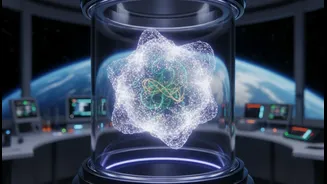
At these extreme temperatures, atoms can enter a bizarre state of matter called a Bose-Einstein Condensate (BEC), first predicted by Satyendra Nath Bose and Albert Einstein in the 1920s. Distinct from solids, liquids, gases, and plasmas, a BEC forms when atoms get so cold and slow that their individual quantum identities merge. Instead of behaving like tiny, separate balls, they act like a single, massive quantum wave. This allows scientists to observe quantum phenomena, which are normally microscopic, on a macroscopic scale. The CAL became the first facility to produce a Bose-Einstein Condensate in Earth orbit, a major milestone for physics. Recent upgrades in 2026 have enhanced the lab, giving researchers even more precise control over the shape and behavior of these quantum gases.
Quantum Leaps in Navigation
One of the most promising applications of this research is in quantum navigation. The technology hinges on a tool called an atom interferometer, which the CAL has successfully demonstrated in space. These instruments use the wave-like properties of ultra-cold atoms to measure acceleration and rotation with extreme precision. By tracking these subtle changes, a quantum navigation system could determine its position without relying on external signals, like those from GPS satellites. This could be revolutionary for deep-space exploration, allowing astronauts to navigate on missions to the Moon or Mars with complete autonomy. It also has significant applications on Earth, potentially leading to ultra-reliable navigation for aircraft and ships that is immune to signal jamming or disruption.
Mapping Gravity's Hidden Secrets
The same atom interferometers that enable quantum navigation are also incredibly sensitive gravity sensors. They can detect minuscule variations in Earth's gravitational field. This capability could be used to build advanced instruments for Earth observation, monitoring everything from the melting of ice sheets and the movement of magma in volcanoes to the location of underground water reserves. By providing a more detailed map of Earth's gravity, this technology offers a new way to understand our changing planet. Furthermore, these ultra-precise measurements could help physicists test some of the most fundamental laws of nature, including Einstein's theory of general relativity, and even probe for mysterious phenomena like dark matter and dark energy.