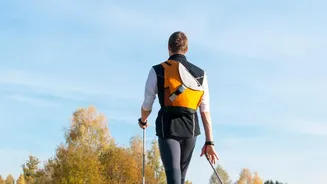




More Than Just a Walk in the Park
You’ve probably seen them: walkers striding purposefully through parks and on trails, poles in hand. This is Nordic walking, an activity that originated in Finland as off-season training for skiers. Its recent revival in popularity is no surprise. It offers
a low-impact, full-body workout that's accessible to people of all ages and fitness levels. Unlike regular walking, which primarily engages the lower body, Nordic walking uses specialised poles to bring the upper body into play, transforming a simple stroll into a comprehensive exercise that engages up to 90% of your body's muscles. Studies show it can burn up to 46% more calories than regular walking and significantly improves cardiovascular health, posture, and balance.
The Engine Room: Why Technique Is Everything
The true power of Nordic walking is only unlocked when the technique is correct. Without it, you are simply carrying poles. Proper form is what engages your arms, shoulders, chest, and back muscles, turning your walk into a powerful, propulsive movement. A correct arm swing, which should be a pendulum motion from the shoulder with a straight arm, works the upper arm and mid-back. This propulsive push-off with the poles not only powers you forward but also reduces the stress on your knees and hips, making it an excellent option for those with joint concerns. Furthermore, the specific action of gripping and releasing the pole handle with each stride helps boost circulation. Simply put, technique is the difference between an effective workout and an inefficient one.
Common Mistakes and Their Consequences
It's easy to fall into bad habits, which can negate the benefits and even lead to strain. A frequent error is planting the poles too far in front of the body, like a hiking stick, which actually acts as a brake and slows you down. Another is using bent elbows instead of a full arm swing from the shoulder; this can quickly tire out your arms and may even lead to issues like tennis elbow. Many beginners also forget the slight forward lean from the ankles that engages core muscles, or they fall out of sync, moving the arm and leg on the same side together instead of in opposition. Incorrect pole height is another critical error. Poles that are too short can cause you to slouch, while poles that are too long can strain your shoulders.
Unlocking the Full-Body Benefits
To get it right, focus on a few key elements. First, ensure your poles are the correct height; your elbow should be at a 90-degree angle when you stand upright and hold the grip with the pole tip on the ground. The motion should be a natural, opposite arm-and-leg movement—as your left leg steps forward, your right arm swings forward, and vice-versa. Instead of planting the pole in front, think of the pole tip landing beside your heel. The power comes from pushing the pole behind you. As you push off, your arm should straighten fully, and you should open your hand to let the pole swing forward via the strap. This active push-off is what engages your triceps, back, and shoulders. Maintain a tall posture and rotate your torso slightly with each stride to activate your core. It takes practice, but this coordinated movement is what delivers the total-body results.