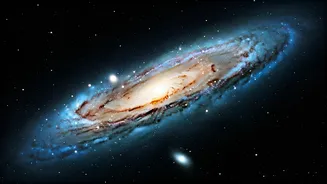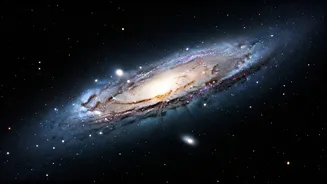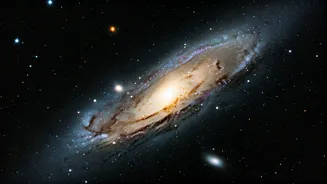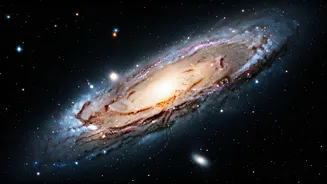




A Beautiful, Chaotic Mess
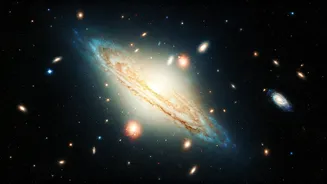
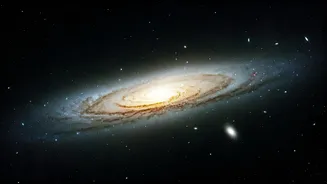
Messier 82, nicknamed the Cigar Galaxy for its elongated shape, is not a quiet cosmic neighbour. Located in the constellation Ursa Major, it is what astronomers call a 'starburst' galaxy. This means it's forming new stars at a blistering pace—about ten
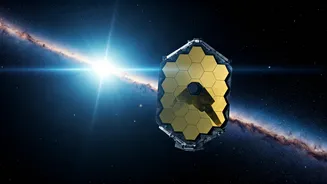
times faster than our entire Milky Way galaxy. This frenzy is believed to have been triggered by a gravitational tug-of-war with its larger neighbour, M81, which sent gas pouring into M82's core. For decades, astronomers have been desperate to understand this process, but a thick curtain of interstellar dust has shrouded the galaxy's heart. Previous telescopes like Hubble gave us tantalising glimpses, but they couldn't fully penetrate the smog. This made M82 a prime target for the James Webb Space Telescope (JWST), whose powerful instruments are designed to see the universe in infrared light, a spectrum invisible to the human eye but perfect for peering through cosmic dust.
Webb's Infrared Advantage
The latest observations of M82 are the result of a dedicated survey using Webb's Near-Infrared Camera, or NIRCam. By staring at the galaxy for 65 hours, scientists were able to gather an unprecedented amount of data. Where other telescopes saw only opaque dust clouds, Webb's infrared vision resolved the scene into stunning detail. The new images have pinpointed approximately 16.5 million individual stars, providing a high-resolution map of the galaxy's structure. This allows astronomers to move beyond simply looking at a beautiful image and start treating the galaxy as a massive dataset. According to one research team member, the sheer number of stars resolved is incredible and opens up a whole new world compared to what was previously possible. By analysing the distribution, age, and motion of these stars, scientists can begin to piece together M82's complex history.
Decoding the Galactic Wind
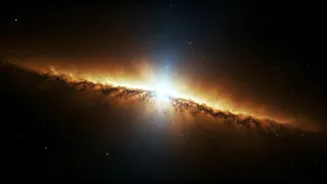
One of the most dramatic features of the Cigar Galaxy is the colossal outflow of material being blasted from its core. This 'superwind' is the result of the intense star formation. The combined energy from thousands of young, massive stars and the supernovae that mark the end of their short lives drives gas and dust out of the galaxy in two massive plumes. Webb's new data provides the clearest view yet of this galactic wind. Specifically, the telescope was able to trace the structure of sooty chemical molecules known as polycyclic aromatic hydrocarbons (PAHs). These tiny dust grains are crucial tracers of what's happening in the space between stars. Webb’s imagery shows these PAHs forming clumpy, red filaments that extend vertically above and below the galaxy's disk, revealing the intricate channels through which material is being ejected. Understanding this process is key to figuring out how galaxies regulate their growth and distribute heavy elements into the cosmos.
From a Fuzzy Cigar to a Cosmic Laboratory
The Webb data isn't just about the wind; it's also revolutionising our understanding of the star formation happening at its source. The intense rate of star birth in M82 is self-limiting; eventually, the process will become so vigorous that it consumes or destroys all the raw material needed to make more stars, and the starburst will end. By piercing through the dust, Webb is able to see massive star clusters in the process of formation, something previously obscured from view. These observations reveal a distorted and asymmetrical shape to the galaxy’s disk, further evidence of its violent past interactions. For scientists, M82 is no longer just a picturesque object but an ideal laboratory for studying galaxy evolution. The combination of Webb's new infrared data with archival observations from telescopes like Hubble gives astronomers a complete toolset to unpack the mysteries of this unique and dynamic celestial object.