


An Unblinking Eye in a Perfect Spot
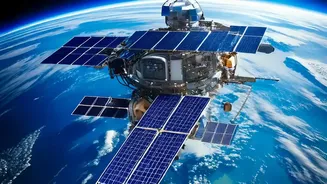
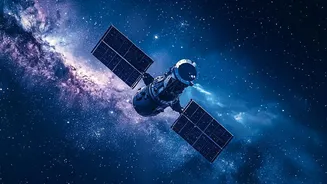
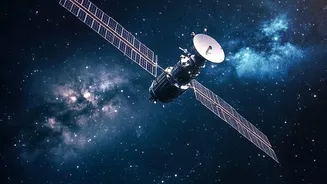
The Aditya-L1 mission represents a giant leap for Indian space science. Its destination is a unique spot in space called Lagrange Point 1, or L1. Think of L1 as a perfect parking spot between the Sun and Earth. Here, the gravitational pulls of both celestial
bodies balance each other out, allowing a spacecraft to hover with minimal fuel. This gives Aditya-L1 a continuous, uninterrupted view of the Sun, free from the eclipses and atmospheric distortion that would occur in an Earth orbit. It's from this vantage point that ISRO can conduct in-situ, or on-site, analysis of the solar environment. This is crucial for understanding the constant stream of particles flowing from the Sun.
What is Solar Wind?
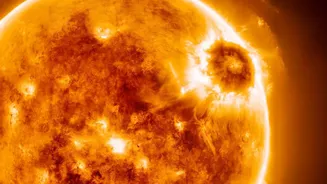
Solar wind is not like wind on Earth. It's a continuous flow of plasma—primarily superheated protons, electrons, and alpha particles—that escapes the Sun's incredibly hot outer atmosphere, the corona. This 'wind' travels at incredible speeds, ranging from a 'slow' 400 kilometres per second to a blistering 750 kilometres per second or even faster during solar storms. When these gusts of charged particles, especially from powerful events like Coronal Mass Ejections (CMEs), reach Earth, they can interact with our planet's magnetic field. This interaction is what causes beautiful auroras, but it can also wreak havoc on our technology-dependent world, disrupting satellites, power grids, and communication systems. This is why measuring it is so important.
The Key Instrument: ASPEX
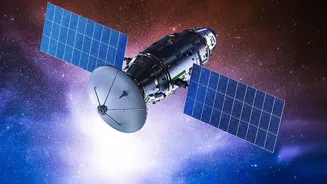
To measure the solar wind, Aditya-L1 carries a suite of seven advanced instruments. Two of these are specifically designed for in-situ particle analysis: the Plasma Analyser Package for Aditya (PAPA) and the Aditya Solar wind Particle EXperiment (ASPEX). While PAPA focuses on analysing the composition and energy distribution of solar wind, ASPEX is the primary tool for understanding how these particles are accelerated to such extreme velocities. Developed by the Physical Research Laboratory in Ahmedabad, ASPEX is engineered to study the origin of the solar wind by measuring both its slow and fast components, especially the high-energy particles that accompany major solar events like CMEs.
How it 'Catches' the Wind
ASPEX itself consists of two sophisticated sub-instruments: the Solar Wind Ion Spectrometer (SWIS) and the SupraThermal and Energetic Particle Spectrometer (STEPS). Think of them as a two-part system for catching and analysing space particles. SWIS acts like a highly advanced wind vane and speed gun combined. It has two sensors that provide a 360-degree view, allowing it to measure the direction and energy of incoming ions like protons and alpha particles in the lower energy range. This helps determine their speed and origin. STEPS, on the other hand, is designed to catch the really fast ones. It focuses on the supra-thermal and high-energy particles—those accelerated by solar flares and CMEs—in a much higher energy bracket. By analysing the number, energy, and direction of these different particles, scientists can build a comprehensive picture of the solar wind's behaviour.
Why This Data Matters for India and the World
The data collected by ASPEX and PAPA is more than just academic. By measuring the solar wind at L1, Aditya-L1 acts as an early warning system. Since L1 is 1.5 million kilometres away, we get a crucial heads-up—anywhere from 30 to 60 minutes—before a powerful solar storm hits Earth. This warning provides time to put satellites into safe mode and protect vulnerable power grids. For instance, an increased ratio of alpha particles to protons, which SWIS can detect, is a known marker for an incoming CME. This capability not only advances our fundamental understanding of the Sun but also solidifies India's position as a major player in space science and global space weather monitoring, contributing to the safety of critical infrastructure worldwide.