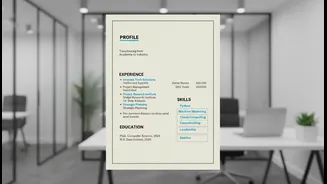









Swap Your CV for a Résumé
The first and most crucial step is understanding that you are not editing your CV; you are creating a new document called a résumé. An academic CV is a detailed, often multi-page, history of your scholarly achievements, including publications, conferences,
and teaching experience. In contrast, an industry résumé is a concise, tailored marketing document, typically one to two pages long, designed to show a recruiter exactly how you fit a specific role. Recruiters spend mere seconds on each application, so brevity and relevance are paramount. While in India the terms CV and résumé are sometimes used interchangeably, for corporate jobs, the concise résumé format is the standard.
Translate Jargon and Focus on Transferable Skills
Academic work is often filled with technical jargon that is inaccessible to a non-specialist, like an HR manager or a hiring lead in a different department. Avoid this by translating your experience into plain language. For example, instead of detailing a niche research topic, focus on the transferable skills you used: problem-solving, data analysis, project management, and critical thinking. A PhD in India, for instance, equips you with skills in logical reasoning and project management that are highly valued in sectors like tech and biotech. Frame your experience by highlighting how your skills can solve business problems and contribute to company goals.
Quantify Your Achievements
Industry hiring managers look for impact. Instead of listing duties, showcase your accomplishments using numbers. An academic CV lists publications, but a résumé should quantify their impact. Rather than just stating you “managed a lab,” you could say you “managed a budget of ₹XX lakh and supervised a team of five researchers, improving project efficiency by 15%.” Quantify wherever possible: the size of the teams you led, the number of people who attended an event you organised, the budget you managed, or the audience for your presentations. This provides concrete evidence of your capabilities and helps your achievements stand out.
Restructure Academic-Specific Sections
Sections that are central to an academic CV need to be rethought for an industry résumé. A long list of publications or conference presentations is unlikely to impress a corporate recruiter. Instead, create a “Selected Publications” section and list only the most relevant and high-impact ones, or omit it entirely and make the list available upon request. Similarly, reframe teaching experience to highlight skills in communication, training, and leadership. Your goal is to curate your experience, not to provide an exhaustive list. Everything on your résumé should serve the purpose of getting you an interview for that specific job.
Tailor for Every Application
Unlike a one-size-fits-all academic CV, your industry résumé must be tailored for every single job application. Carefully analyse the job description to identify keywords and required skills. Use these keywords throughout your résumé to pass through Applicant Tracking Systems (ATS), the software companies use to screen applications. Each version of your résumé should highlight the experiences and skills that are most relevant to that specific role, demonstrating a clear and immediate fit with the employer's needs. This targeted approach shows you have done your research and are genuinely interested in the position.