



The Downhill Problem
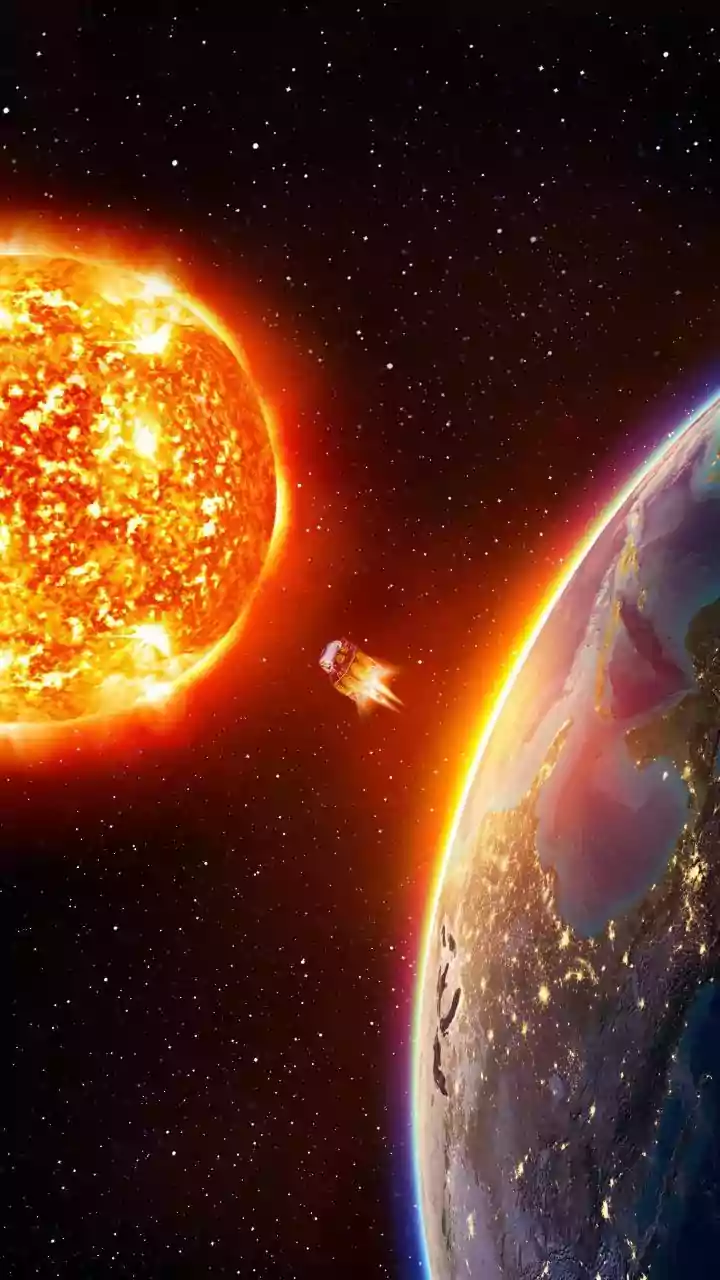
You might think a trip towards the inner solar system is like rolling downhill—and you'd be right. That’s the core problem. The Sun contains 99.8% of the solar system's mass, creating an enormous gravity well. A spacecraft leaving Earth's orbit and heading
inward starts 'falling' toward the Sun. As it falls, it accelerates to incredible speeds. Going to an outer planet like Mars or Jupiter is like throwing a ball uphill; it naturally slows down as it fights gravity. But a probe to Mercury is like throwing a bowling ball down a steep mountain; it arrives moving far too fast to be captured by Mercury's weak gravity. Without a way to slow down, it would simply zip past the planet and continue its journey around the Sun.
Putting on the Brakes with Billiards
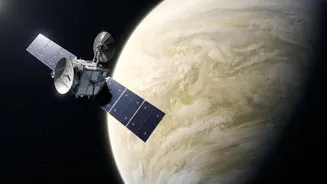
So, how do you slow down in the vacuum of space? Using only rockets to brake would require an impossible amount of fuel, making the spacecraft too heavy to launch in the first place. Instead, mission planners use a clever technique called a gravity assist. This is where the spacecraft performs a close flyby of a planet, using its gravity like a slingshot in reverse to shed speed and alter its trajectory. This method of 'cosmic billiards' is essential for reaching Mercury. BepiColombo, which launched in October 2018, was designed to perform a complex series of nine flybys to gradually reduce its energy. This intricate dance involves one flyby of Earth (in 2020), two of Venus (in 2020 and 2021), and an incredible six flybys of Mercury itself before it can finally settle into orbit.
The Long and Winding Road
This series of flybys is the main reason for BepiColombo's long journey. Each manoeuvre must be timed perfectly, sometimes waiting years for the planets to align correctly. The spacecraft has to loop around the inner solar system repeatedly, with each pass acting as a brake, gradually shrinking its orbit to match Mercury's. The mission was initially planned to take about seven years, arriving in late 2025. However, a power-related issue with the craft's solar electric propulsion system meant it couldn't operate at full thrust. Engineers devised a new, lower-thrust trajectory that saved the mission but extended the journey, pushing the final arrival to November 2026. This extended timeline brings the total journey time closer to eight years, a testament to both the difficulty of the task and the ingenuity of the team.
Surviving the Solar Inferno
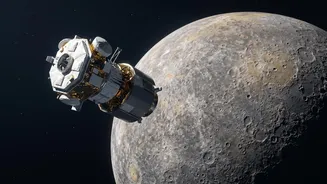
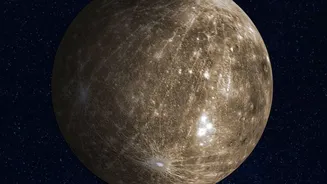
As if the orbital mechanics weren't challenging enough, there's also the environment. Mercury is the least explored planet in the inner solar system partly because it is an incredibly harsh place to visit. Being so close to the Sun, a spacecraft in orbit must endure extreme heat and radiation. Temperatures can soar high enough to melt lead, requiring sophisticated sunshields, radiators, and specially designed materials to protect the delicate scientific instruments. BepiColombo is actually two spacecraft in one: the European Space Agency’s Mercury Planetary Orbiter (MPO) and the Japan Aerospace Exploration Agency’s Mercury Magnetospheric Orbiter (Mio). These two orbiters, which traveled together, will separate upon arrival to study the planet from different vantage points, a feat only attempted once before by NASA's MESSENGER mission.