






The Garden City's Blooming Business
Bengaluru, and Karnataka at large, stands as the heart of India's floriculture sector, accounting for a significant portion of the nation's total flower production. The region's favourable climate and advanced farming techniques have cultivated a reputation
for high-quality roses, gerberas, and carnations sought after in markets across the globe, including Europe, Japan, and Australia. The International Flower Auction Bangalore (IFAB) is a testament to this scale, handling millions of flower stems. The government has even declared floriculture a "sunrise industry" with 100% export-oriented status, signalling its vast economic potential. Yet, despite this strong foundation, the journey from farm to foreign consumer is fraught with peril, preventing the industry from reaching its full, multi-billion dollar potential.
A Race Against Time: The Cold Chain Challenge
The primary obstacle for floriculture exporters is the highly perishable nature of their product. Cut flowers begin to deteriorate the moment they are harvested, and their vase life is significantly shortened by exposure to heat. This makes an unbroken "cold chain"—a temperature-controlled supply line from farm to cargo plane—absolutely essential. However, establishing and maintaining this chain is a major challenge in India. Post-harvest losses in the country's floriculture industry are estimated to be as high as 30-40%, largely due to inadequate storage and transport infrastructure. Growers face unreliable grid electricity for conventional refrigeration units and high operational costs, all of which eat into their margins and limit their ability to compete with established global players from Kenya and the Netherlands.
How Solar Power Changes the Equation
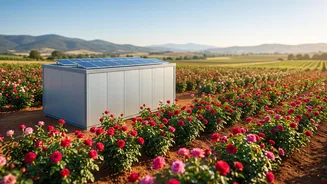
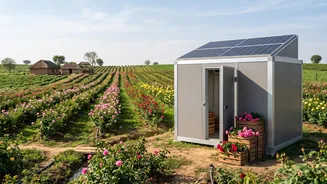
Solar-powered refrigeration offers a direct and powerful solution to these core challenges. These systems, which range from walk-in cold rooms to larger pack-house facilities, use photovoltaic (PV) panels to generate electricity, often storing excess energy in batteries for round-the-clock operation. For floriculture, the benefits are transformative. Firstly, they decouple cold storage from the often-unreliable local power grid, ensuring consistent cooling that is critical for preserving flower quality. This is particularly vital in rural and semi-urban growing areas where power outages can be frequent. Secondly, by harnessing a free and abundant energy source, solar refrigeration drastically reduces operational expenditure, freeing farmers from volatile electricity tariffs and expensive diesel generators. This cost-saving is a crucial competitive advantage.
Unlocking Economic and Sustainable Growth
By tackling the twin problems of spoilage and energy costs, solar-powered refrigeration is key to scaling exports. With access to reliable pre-cooling and cold storage, growers can significantly extend the shelf life of their flowers. This reduces post-harvest losses, directly increasing the volume of sellable product and boosting profitability. It also gives them the confidence to pursue more distant and lucrative markets, which were previously unreachable due to the risk of spoilage during longer transit times. Furthermore, adopting green technology enhances the sustainability credentials of Bengaluru's exports. In an era where international buyers are increasingly conscious of environmental impact, being able to market flowers grown and preserved using renewable energy provides a powerful selling point and a distinct competitive edge.
The Path to Widespread Adoption
While the benefits are clear, the primary barrier to the widespread adoption of solar-powered cold storage remains the initial capital investment. To overcome this, a combination of government support and innovative financing models is essential. Financial assistance through schemes like the National Horticulture Mission and the Agriculture Infrastructure Fund can help de-risk the investment for individual farmers and farmer producer organisations (FPOs). As more success stories emerge, demonstrating a clear return on investment through reduced waste and higher export revenues, the momentum for adoption will build. For Bengaluru's floriculture sector, embracing this technology is not merely an operational upgrade; it is a strategic necessity for securing a more profitable and sustainable future on the world stage.