






A Thanksgiving Festival Born from an Epidemic
At its heart, Bonalu is a festival of gratitude. Its origins trace back to 1813, when a devastating plague swept through the twin cities of Hyderabad and Secunderabad, claiming thousands of lives. According to historical accounts, a military battalion
from Hyderabad stationed in Ujjain, Madhya Pradesh, prayed to the Goddess Mahakali, vowing to build a temple for her if their home city was saved. When the plague subsided, the soldiers fulfilled their promise, installing an idol of the Goddess and making a food offering, or 'Bonam'. This act of collective thanksgiving evolved into the annual tradition that is now recognised as the state festival of Telangana.
The Ritual of the Bonam Offering
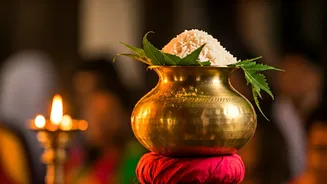
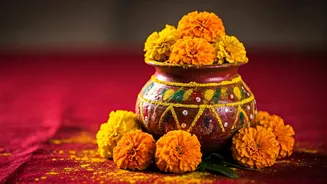
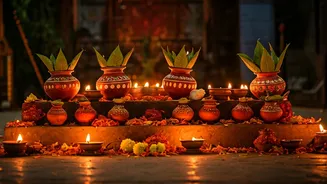
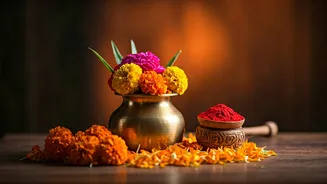
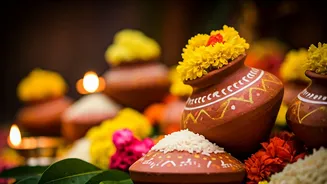
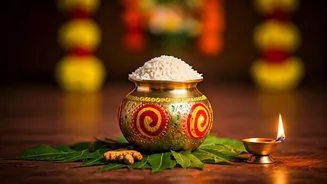
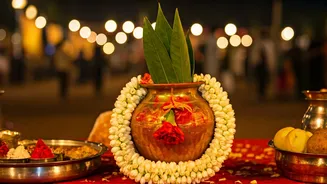
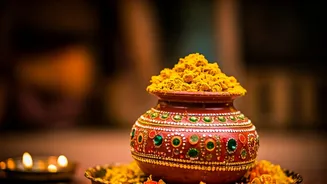
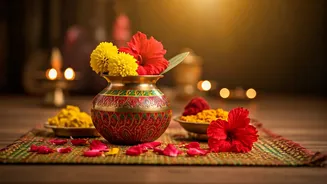
The name 'Bonalu' is the plural of 'Bonam', which derives from the word 'Bhojanam', meaning meal in Telugu. This offering is the festival's central ritual. Women dress in traditional silk sarees and jewellery, preparing rice cooked with milk and jaggery. This is placed in a new brass or earthen pot, which is then decorated with turmeric, vermilion, and purifying neem leaves, with a lit lamp placed on top. Balancing these ornate pots on their heads, they proceed to the temple, often in a trance-like state, dancing to rhythmic drum beats. It is believed that these women are possessed by the spirit of the Mother Goddess, and onlookers often sprinkle water on their feet to pacify the aggressive spirit.
Pothuraju: The Fierce Protector
Leading the processions is a formidable figure known as Pothuraju, considered the brother of the Goddess Mahakali. Typically played by a well-built, bare-bodied man, he is a striking sight. His body is smeared with turmeric, and his forehead is marked with bright red vermilion. Armed with a thick whip, he dances energetically to the powerful drum beats, clearing the path for the women carrying the Bonam offerings and acting as the protector of the procession. The Pothuraju is considered the initiator of the festivities and a guardian of the community against evil spirits.
A Month-Long Celebration Across the City
Bonalu is not a single-day event but a month-long festival celebrated during the Hindu month of Ashada, which typically falls in July and August. The festivities for 2026 are scheduled across four Sundays: July 19, July 26, August 2, and August 9. The celebrations begin at the Jagadamba temple at the historic Golconda Fort on the first Sunday. They then move to the Ujjaini Mahakali Temple and Balkampet Yellamma temple in Secunderabad on the second Sunday, and finally to the Lal Darwaza temple in Hyderabad's Old City on the third Sunday, before culminating in further processions.
Rangam and Ghatam: Prophecy and Procession
Two other key rituals are 'Rangam' and 'Ghatam'. Rangam, which means 'performing the oracle', takes place the morning after the main festival day. A woman, believed to be channeling the Goddess, stands on an unbaked earthen pot and delivers prophecies for the year ahead. The festival concludes with the 'Ghatam' procession. A copper pot, decorated to represent the Goddess, is carried by a priest through the streets, accompanied by drumming and celebration, before it is finally immersed in water. The Ghatam procession from the Akkanna Madanna temple is particularly famous, led by an elephant.