



What Exactly Did Scientists See?
Scientists have detected what is currently the most distant galaxy ever confirmed, a faint reddish smudge named JADES-GS-z14-0. This isn't just another galaxy; its light began its journey to us when the universe was only about 290 million years old, a mere
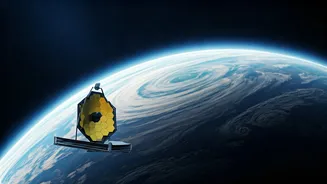
2% of its current age. We are essentially seeing a snapshot from the cosmic dawn, the period when the very first stars and galaxies ignited, ending the cosmic 'dark ages' that followed the Big Bang. The discovery was made by an international team of astronomers using the James Webb Space Telescope (JWST) as part of the JWST Advanced Deep Extragalactic Survey (JADES) program.
The Universe's Ultimate Time Machine
Looking at distant objects in space is the same as looking back in time. Because light travels at a finite speed, the light from JADES-GS-z14-0 has spent over 13.5 billion years crossing the expanding universe to reach the mirrors of the JWST. The telescope acts as a time machine, allowing us to witness conditions from an era we could previously only simulate. The expansion of the universe stretches the wavelength of this ancient light, shifting it towards the red end of the spectrum, a phenomenon called 'redshift'. By precisely measuring the redshift of JADES-GS-z14-0, astronomers confirmed its incredible distance and age, shattering previous records.
Rewriting the Cosmic Storybook
This discovery is more than just a new record; it's forcing a rewrite of the first chapter of the universe's history. JADES-GS-z14-0 is surprisingly large and luminous, far brighter than theories predicted would be possible so early in cosmic history. The presence of such a well-developed galaxy suggests that the processes of star and galaxy formation were more rapid and efficient than our models accounted for. It's as if the universe went from zero to a hundred in record time. Furthermore, observations have detected oxygen within this infant galaxy, indicating that at least one generation of stars had already lived, died, and seeded their surroundings with heavier elements—a process thought to take much longer.
A Glimpse of Our Cosmic Ancestors
The light from these first galaxies is not just a scientific curiosity; it tells the story of our own origins. The early universe was composed almost entirely of hydrogen and helium. Every other element—the oxygen we breathe, the carbon in our cells, the iron in our blood—was forged inside stars. Observing these first stellar factories in action helps us understand how the universe became chemically enriched enough to eventually form planets and, on at least one of them, life. These early, massive stars produced huge amounts of ultraviolet radiation that played a crucial role in the 'Epoch of Reionization', a transformative period when the opaque hydrogen fog of the dark ages was cleared, making the universe transparent as it is today.
The Next Frontier in Space
The discovery of JADES-GS-z14-0 is not an end, but a spectacular beginning. Each new observation from the James Webb Space Telescope pushes the frontier further back in time. Scientists are now hunting for even earlier, fainter galaxies to understand the full timeline of the cosmic dawn. These findings raise new questions: How did the first supermassive black holes form so quickly? Were the first stars different from those today? How common were these surprisingly mature galaxies in the early universe? Finding the answers will continue to refine our understanding of where everything, including ourselves, came from.