





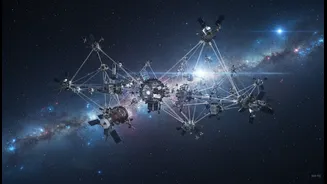
What is Microgravity, Anyway?
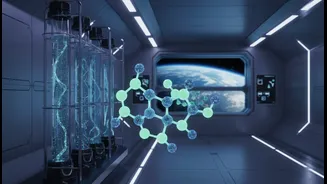
Microgravity is the condition of near-weightlessness experienced in space, where the pull of gravity is extremely weak. It's not a total absence of gravity, but a state where its effects are so minimal that objects and people float. This unique environment
acts as a pristine laboratory, allowing scientists to observe physical and biological phenomena without gravity’s constant, distorting influence. On Earth, gravity causes denser materials to settle and lighter ones to rise, affecting everything from how fluids mix to how cells organize. In space, these rules don't apply, opening up a new playbook for scientific discovery.
The Zero-G Laboratory
The applications of microgravity research are vast and transformative, with the potential to create breakthroughs for life on Earth. In pharmaceuticals, for instance, protein crystals grow larger and more perfectly in space, allowing scientists to map their structures with incredible precision. This is critical for designing more effective drugs with fewer side effects. Beyond medicine, microgravity is a game-changer for materials science, enabling the creation of advanced alloys and optical fibers with properties impossible to achieve on the ground. It also holds the key to long-duration human spaceflight, with research focusing on everything from muscle atrophy and bone loss to growing food in space and recycling life support systems.
India’s Orbital Ambitions
India is making a concerted push into this high-tech frontier. The upcoming Gaganyaan program, India’s first human spaceflight mission, is a cornerstone of this strategy. While sending Indian astronauts to orbit is a monumental achievement in itself, the mission will also serve as a platform for a suite of microgravity experiments. ISRO has already outlined experiments in fields like life sciences and physics. This initiative is part of a broader vision that includes establishing the Bharatiya Antariksh Station by 2035. To foster a robust research ecosystem, ISRO has launched programs like the Indian Microgravity Experiments (IMEx-2026), inviting proposals from the national science community to develop experiments for future space missions.
A New Frontier for Startups
The government's decision to open the space sector to private players has catalyzed a new wave of innovation. The Indian National Space Promotion and Authorisation Centre (IN-SPACe) is actively enabling this shift, turning space into a domain for commercial enterprise. A growing number of Indian startups are now building technologies specifically for the microgravity economy. Companies like Vellon Space are developing platforms that act as 'micro space stations' for automated experiments. Chennai-based Inbound Aerospace is creating reusable spacecraft to offer 'microgravity as a service,' aiming to make space-based research faster and more accessible for industries like pharma and semiconductors. Others, like Andhra Pradesh-based AnduraX, are working on reusable re-entry vehicles to bring back manufactured goods from space.
The Commercial and Strategic Payoff
This trend is not just about scientific curiosity; it's about securing India’s place in the future global economy. In-space manufacturing and research represent a burgeoning market with massive potential. By developing indigenous capabilities, India aims to become a key player, providing services to both domestic and international clients. The Indian Space Policy 2023 explicitly encourages private sector participation and human spaceflight to advance scientific research in microgravity. This focus is expected to generate technological spin-offs, create high-skilled jobs, and enhance India's diplomatic influence. From developing novel drugs for diseases prevalent in the developing world to creating next-generation materials, the economic and social benefits are poised to be significant.