






The Problem: 'Desk Body' Is Real
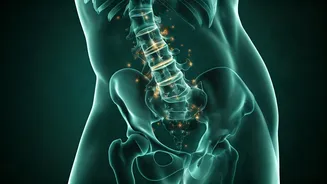
Let's be honest. Most of us spend upwards of eight hours a day hunched over a laptop. This sedentary lifestyle leads to a cluster of common issues often dubbed 'desk body': tight hips, a sore lower back, rounded shoulders, and a stiff neck. Over time,
this poor posture doesn't just cause discomfort; it can drain your energy, reduce focus, and contribute to chronic pain. The good news is that you don't need a full hour-long yoga class to fight back. By integrating short, targeted stretching breaks into your workday, you can actively counteract these effects, improve blood flow, and keep your body feeling agile and awake.
1. Seated Cat-Cow (Marjaryasana-Bitilasana)
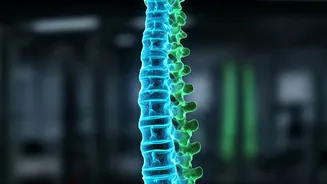
Your spine bears the brunt of slouching. The Seated Cat-Cow is a gentle dynamic movement that increases spinal flexibility and relieves tension in the back and neck. **How to do it:** Sit on the edge of your chair with both feet flat on the floor. Place your hands on your knees. As you inhale (Cow Pose), arch your back, push your chest forward, and look up slightly, creating a gentle curve in your spine. As you exhale (Cat Pose), round your spine, tuck your chin to your chest, and let your shoulders roll forward. Repeat this fluid movement 5-10 times, syncing your breath with the motion. It’s like a mini-massage for your vertebrae.
2. Seated Spinal Twist (Ardha Matsyendrasana variation)
Twists are fantastic for digestive health and relieving lower back pain. A seated twist helps to decompress the vertebrae and stretch the muscles along the sides of your torso. **How to do it:** Sit tall in your chair, with your feet firm on the ground. Inhale to lengthen your spine. As you exhale, gently twist your torso to the right. Place your left hand on the outside of your right knee and your right hand on the back of the chair for support. Keep your hips facing forward as you deepen the twist with each breath. Hold for 30 seconds, then slowly return to the centre and repeat on the left side. Avoid forcing the twist; move only as far as is comfortable.
3. Eagle Arms (Garudasana Arms)
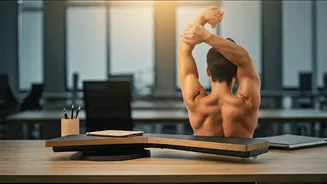
Typing and using a mouse can lead to incredible tension across the upper back and shoulders. Eagle Arms provide a deep, targeted stretch for this hard-to-reach area. **How to do it:** Extend both arms straight in front of you. Cross your right arm over your left, then bend your elbows. Bring the backs of your hands together, or if you have the flexibility, wrap your right hand around to press your palms together. Gently lift your elbows up and press your hands away from your face to intensify the stretch between your shoulder blades. Hold for 20-30 seconds, breathing deeply into your upper back. Unwind and switch sides, crossing the left arm over the right.
4. Seated Figure-Four Stretch (Sucirandhrasana variation)
Sitting for prolonged periods shortens and tightens your hip flexors and glutes, contributing to lower back pain. This stretch, also known as Seated Pigeon Pose, is a perfect antidote. **How to do it:** While seated, cross your right ankle over your left knee, creating a 'figure four' shape. Keep your right foot flexed to protect your knee. You may already feel a stretch in your right hip and glute. To deepen it, sit up tall and gently press down on your right knee, or hinge forward at your hips with a straight back. Hold for 30 seconds, feeling the tension release. Switch legs and repeat.
5. Wrist and Finger Extensor Stretch
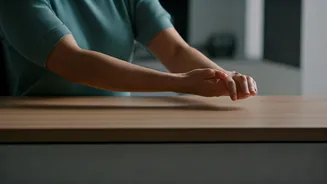
Don't forget your hands! Hours of typing can lead to repetitive strain. Simple wrist and finger stretches can prevent stiffness and conditions like carpal tunnel syndrome. **How to do it:** Extend your right arm in front of you, palm facing down. With your left hand, gently bend your right wrist down, pointing your fingers toward the floor. You should feel a stretch along the top of your forearm. Hold for 20 seconds. Next, flip your hand so the palm faces up and use your left hand to gently pull your fingers back towards your body. Hold for another 20 seconds. Repeat on the other arm. Finish by making tight fists and then spreading your fingers wide, repeating 5 times.