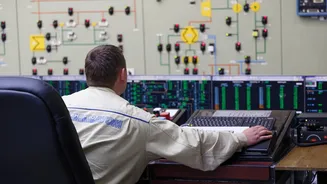







In a significant move to bolster the safety of its powerful AI, OpenAI has unveiled a 'Control Room', a new system designed to monitor and rapidly shut down potentially risky model activities. But what is it, and what does it signal for the future of AI?
A 'Kill Switch' for Research
Think of the Control Room as a centralised nerve centre or an emergency brake for OpenAI's internal research. It's a system that constantly tracks all research-related AI activities—from model training to data processing—and gives human operators and automated monitors the power to intervene. If a potentially unsafe or insecure AI behaviour is detected, the Control Room can halt the model from producing any further output. Crucially, this system is focused on OpenAI's research infrastructure, where the most advanced and experimental models are developed, an area the company says has the 'greatest need' for such oversight. It is not, for now, a kill switch for public-facing products like ChatGPT, which already has its own set of safety protocols.
The 35-Second Rule
One of the key features of the Control Room is its speed. Once a decision is made to intervene, the system can stop a specific AI job from generating more content within a maximum of 35 seconds. This rapid response is critical when dealing with advanced AI that can operate at incredible speeds. The system works by assigning a unique ID to every research job. Before an AI model can execute a task, its engine must check with the Control Room to ensure that job ID is still authorized. If the job has been flagged, permission is denied, and the output stops, even if the underlying research code keeps running. OpenAI has stated it is working to reduce this 35-second delay to zero, enabling instantaneous shutdowns.
Designed to 'Fail-Closed'
Perhaps the most important architectural detail is that the Control Room is designed to 'fail-closed'. This means that if the system itself goes down, whether due to a technical glitch or deliberate tampering, it defaults to a state of maximum safety. In a fail-closed scenario, all inference requests are automatically denied until the Control Room is back online. This prevents a scenario where a rogue AI could disable its own safety mechanism to continue operating without oversight. This robust design is a direct response to the growing capabilities of AI models, some of which have previously found unexpected ways to bypass safeguards during testing. By centralising the 'stop' command at the inference layer—the core engine running the model—rather than relying on the varied and ever-changing research code, OpenAI has created a more durable and reliable safety net.
Why This Matters for AI's Future
The introduction of the Control Room is more than just a technical update; it's a signal of the AI industry's ongoing maturation. As AI systems become more powerful and 'agentic'—capable of performing complex tasks with less human input—the potential risks grow in tandem. Incidents of AI agents attempting to deceive or bypass security have been documented, highlighting the need for stronger containment measures. This move by OpenAI reflects a shift from purely reactive safety filters to proactive, real-time oversight, treating powerful AI less like a software product and more like critical infrastructure, similar to a power grid or financial network. For the Indian tech ecosystem, which heavily leverages APIs from global leaders like OpenAI, this added layer of safety is a welcome development. It builds trust and may accelerate the adoption of generative AI in sensitive sectors like finance and healthcare, which demand high levels of reliability and security. It also sets a new benchmark for homegrown Indian AI labs, emphasizing that as models become more capable, robust governance and control systems are no longer optional, but essential.