


The Atmosphere as a Colour Filter
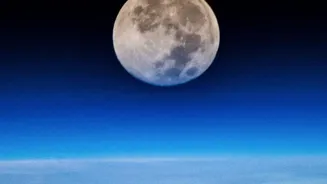
First, it helps to understand why the sky is blue and sunsets are red. Sunlight, which contains all the colours of the rainbow, enters our atmosphere and collides with tiny gas molecules. These molecules are excellent at scattering short-wavelength light, like
blue and violet, in every direction. This process, called Rayleigh scattering, is why our daytime sky looks blue. When the Sun or Moon is near the horizon, its light has to travel through a much thicker slice of the atmosphere to reach our eyes. This long journey means most of the blue light is scattered away before we can see it, allowing the longer wavelengths of light—the reds, oranges, and yellows—to pass straight through. This is why sunrises and sunsets often blaze with fiery colours.
Dust and Smoke: The Intensity Boosters
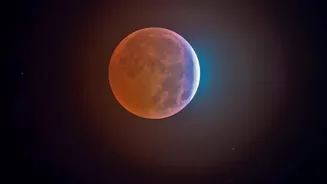
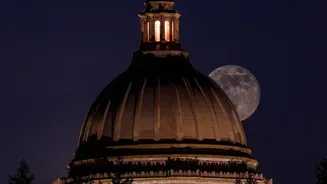
A standard horizon moon often looks pale yellow or light orange. To get that deep, hazy, and sometimes dark orange hue, you need bigger particles in the air. This is where atmospheric aerosols like dust, wildfire smoke, and pollution come into play. These particles are much larger than gas molecules. Light scattering off them is described by a different process called Mie scattering. Unlike Rayleigh scattering, which selectively removes blue light, these larger particles can scatter all colours of light, though not always evenly. They act like a potent, secondary filter. When concentrated in layers, they not only enhance the reddish tint by scattering away even more of the remaining shorter wavelengths but can also absorb some light, making the Moon appear dimmer or darker.
How Dust Layers Create a Dark Orange Glow
Imagine a thin layer of dust from a distant desert or smoke from a major wildfire suspended high in the atmosphere. As moonlight travels through this layer, it’s subjected to intense filtering. The dense concentration of these aerosol particles aggressively strips away any remaining blue and green light. What’s left is a highly concentrated beam of the longest light wavelengths, resulting in a pronounced, deep orange or even reddish colour. Furthermore, some types of particles, like black carbon (soot) from fires or certain mineral dusts, are dark and absorb light instead of just scattering it. This absorption darkens the overall image, which explains why a smoke-infused moon can look not just orange but also hazy and less brilliant than a typical full moon high in the sky.
Seeing the Effect in Real Life
This phenomenon isn't just theoretical; you can see it in action. During intense wildfire seasons, it's common for the moon to appear a startling shade of red or orange, even when it’s high in the sky, because the smoke is so thick and widespread. Similarly, large dust storms can send plumes of fine particles across entire continents, causing hazy, orange moons for days. High humidity and fog can also contribute, as water droplets in the air add to the scattering effect, often producing a soft, amber glow. So, the next time you see a particularly orange moon, you're not just looking at our lunar neighbour; you're seeing a direct visual report on the particles floating in our own atmosphere.