



The Plant-Based Problem
For years, creating a dairy-free frozen dessert that could rival the texture of traditional gelato was a culinary challenge. Traditional gelato gets its dense, silky-smooth feel from a precise balance of milk fat, proteins, sugar, and a slow-churning
process that incorporates very little air. Early attempts at vegan versions, often using thin bases like almond or soy milk, fell short. These low-fat alternatives tended to freeze into solid, icy blocks. Without the emulsifying properties and rich fat content of dairy, the result was often a grainy texture that felt more like a sorbet than a creamy gelato. This left consumers with the impression that plant-based options were an unavoidable compromise, lacking the luxurious mouthfeel that makes gelato so beloved.
Coconut Cream to the Rescue
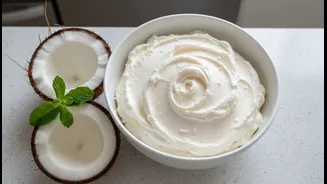
Enter coconut cream. Unlike its watery cousin, coconut milk, coconut cream has a much higher fat content, which is key to mimicking the richness of dairy cream. This fat is crucial for creating a smooth texture and preventing the formation of large ice crystals during freezing. Plant-based fats behave differently than dairy fats when frozen, with some turning hard and crystalline. However, coconut fat has properties that allow it to create the creamy mouthfeel essential for premium ice cream. Its high saturated fat content helps build a stable structure that traps air and water, resulting in a dessert that's dense and melts slowly, just like its dairy-based counterpart. This makes it an ideal foundation for a rich, satisfying plant-based gelato.
It's All in the Formulation
Simply swapping dairy for coconut cream isn't enough to guarantee a perfect scoop. The real art lies in the formulation. Expert gelato makers have discovered that a blend of fats often yields the best results. Studies in food science show that combining a solid fat like coconut oil with a liquid oil can produce the creamiest texture. This is because the process, known as partial coalescence, allows fat globules to clump together just enough to create a stable network that gives the gelato its structure and rich feel. Beyond fats, chefs also carefully balance sugars like dextrose and natural stabilizers like carob bean gum. These ingredients do more than just sweeten; they lower the freezing point and bind with water, further ensuring a smooth, scoopable product free of icy grit.
Innovating Beyond the Base
With a reliable, creamy base established, urban gelaterias are now pushing the boundaries of flavour. While coconut can impart a subtle tropical note, it's often neutral enough to serve as a canvas for a wide range of ingredients. Chefs are creating complex profiles, from deep chocolate and nutty pistachio to bright, fruity combinations. Some shops are even making their own plant-milks in-house or using advanced ingredients like pea protein isolates and modified starches to perfect the structure and taste. These sophisticated techniques allow them to fine-tune the final product, ensuring each flavour has the ideal texture. This level of craft moves vegan gelato from a simple alternative to a gourmet experience in its own right, celebrated for its unique qualities.