




An Anniversary Portrait with a Past
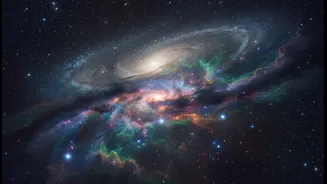
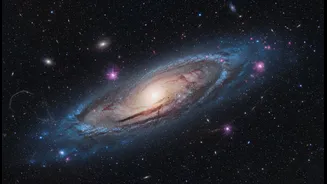
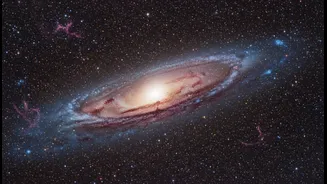
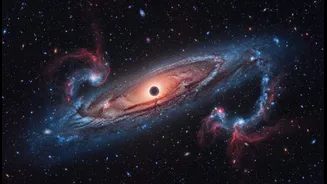
To celebrate its fourth year of groundbreaking science, the team behind the James Webb Space Telescope (JWST) has unveiled a breathtaking new view of Centaurus A. Located just 11 million light-years away, it is one of the closest active galaxies to our own
Milky Way. While astronomers have studied it for decades, Webb's powerful infrared vision cuts through the thick veils of cosmic dust that have long hidden its secrets. What was once a hazy glow in images from telescopes like Hubble has been resolved into a rich tapestry of millions of individual stars, offering an unprecedented look into the galaxy's turbulent life. These new images transform a familiar celestial object into something far more complex and active than ever seen before.
The Scars of a Galactic Collision
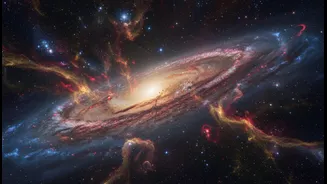
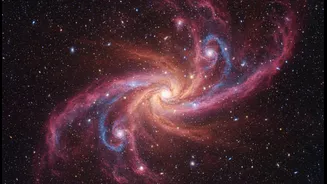
The incredible clarity of Webb’s images reveals that Centaurus A is a galaxy shaped by a violent history. It bears the dramatic scars of a head-on collision with another, smaller galaxy that occurred roughly two billion years ago. The aftermath of this cosmic merger is still visible today in its peculiar structure and ongoing bursts of star formation. Where older telescopes saw only the galaxy's large-scale shape, Webb's Mid-Infrared Instrument (MIRI) reveals the intricate details of this ancient event. This ability to peer into the heart of such a dynamic system provides a powerful laboratory for understanding how galactic mergers drive evolution, fuel black holes, and construct the larger cosmic structures we see across the universe.
A Mysterious Cosmic 'Hook'
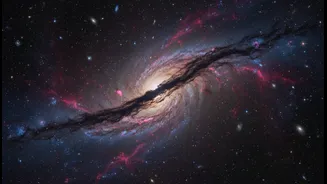
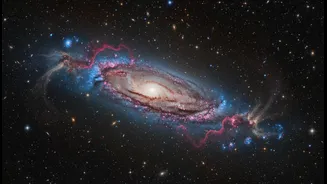
Among the newly revealed details, one feature in particular has perplexed and intrigued astronomers: a strange, S-shaped structure made of glowing dust near the galaxy's center. This sinuous feature, which stands out in the mid-infrared view, is the strong 'hook' that gives Webb a new puzzle to solve. Scientists are now asking what forces could have sculpted the dust into this unusual shape. Is it a remnant of the gravitational chaos from the past merger? Is its form being influenced by the powerful jets streaming from the central black hole? Answering these questions will require further study, but the discovery of this feature highlights how much we still have to learn about the physics of galactic cores.
An Engine of Creation and Destruction
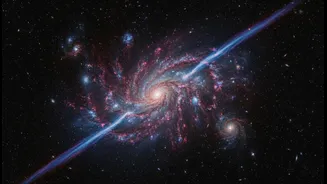
At the heart of Centaurus A lies a supermassive black hole, actively feeding on the gas and dust swirling around it. This cosmic engine is not just passively consuming material; as it feeds, it launches powerful jets of energy that blast out into the galaxy, influencing its shape and the pace of star formation. Webb’s spectroscopic instruments can analyze the light from this region to measure how gas is moving, revealing outflows of ionized gas driven by the black hole's activity. This gives astronomers a direct view of the feedback loop between a galaxy and its central black hole, a key process in understanding how one grows in concert with the other.
Rewriting the Rules of Galaxy Growth
The detailed look at Centaurus A is just one example of how the JWST is fundamentally changing our understanding of 'cosmic construction'. In its first four years, the telescope has consistently found that the early universe was more mature and structured than models predicted. Astronomers have spotted massive galaxies with fully formed stellar bars—structures like the one in our own Milky Way—at a time when they weren't supposed to exist. In another recent discovery, Webb observed a 'protocluster' of six distinct galaxies in the process of merging to form one massive galaxy, a rare glimpse into the assembly of the universe's largest structures just 1.8 billion years after the Big Bang. These findings show that the processes that build galaxies were happening faster and earlier than we ever knew, making Webb's continued observations essential to rewriting the story of the cosmos.