







What Is Structural Stress Testing?
For generations, civil and mechanical engineering students learned about structural integrity through complex calculations and theoretical models. They studied how forces like tension, compression, and torsion affect bridges, buildings, and aircraft.
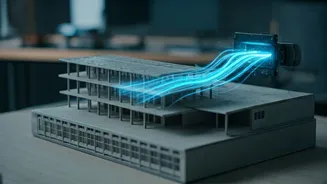
While vital, this approach can feel disconnected from the physical world. Traditionally, physical stress testing was the domain of expensive industrial labs, involving large-scale prototypes tested to destruction. Now, imagine doing this in a classroom. The core idea is to apply a force to a structure—like a small-scale model of a bridge or a building beam—and measure how it responds. The goal is to find weak points and understand how the structure distributes the load before it fails. This process, known as Structural Health Monitoring (SHM), is crucial for ensuring the safety and longevity of our infrastructure, but bringing it into an educational setting in a live, accessible way has always been the challenge.
How AI Hubs Are Changing the Game
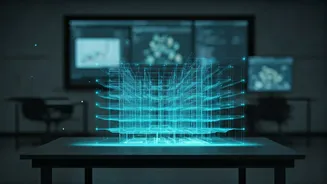
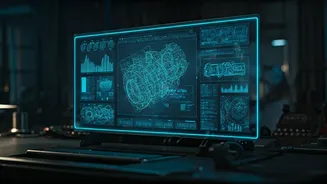
This is where the "AI hub" comes in. It’s not a single, off-the-shelf product but rather an ecosystem of connected technologies. It typically consists of three key components. First, a network of small, affordable sensors (like strain gauges or accelerometers) are attached to various points on a physical model. Second, a data acquisition system collects the information from these sensors in real time. Finally, and most importantly, an AI-powered software platform acts as the central 'brain'. The AI doesn’t just display the raw data. It processes it, running complex simulations to create a 'digital twin'—a virtual replica of the physical model. As a student applies pressure to the real-world model bridge, they can watch the digital twin on a screen light up in a colour-coded heat map, showing exactly where the stress is concentrating. The AI can predict failure points, compare real-world data to theoretical models, and highlight discrepancies, providing instant feedback that was previously impossible to get outside a professional lab.
Inside the AI-Powered Classroom
Picture this: a group of engineering students at an IIT or NIT has just built a miniature bridge from a kit. They attach tiny sensors along its trusses and deck. One student uses a device to apply a slow, steady load, simulating the weight of traffic. On a large monitor at the front of the room, the entire class watches the bridge's digital twin. As the weight increases, red and orange spots bloom along a critical support beam, indicating high stress. The AI hub can flag that this beam is approaching its theoretical failure point. The students can then pause, reinforce the model, and test it again, immediately seeing the impact of their design change. This iterative loop of building, testing, and refining—all within a single class period—transforms learning from a passive activity into an active, engaging experiment. It helps students develop an intuitive feel for physics and material science, a 'sixth sense' for structural behaviour that can't be learned from a book.
Why This Matters for India's Future
This isn't just a cool gadget for a few elite universities; it's a critical tool for training the next generation of nation-builders. India is in the midst of an unprecedented infrastructure boom, from the construction of new highways, high-speed rail networks, and smart cities to the retrofitting of older structures. The quality and safety of these projects depend entirely on the skill of the engineers who design and maintain them. By equipping students with tools that bridge the gap between abstract theory and real-world consequences, we are cultivating a generation of engineers who are not just proficient in calculation but are also deeply intuitive problem-solvers. They will enter the workforce with practical experience in identifying structural vulnerabilities, making them better prepared to design the resilient, safe, and durable infrastructure India needs for the coming decades. This technology democratises high-level experimental learning, potentially leveling the playing field for engineering institutions across the country.