





The Ghostly Fingerprint in Starlight
So, how do scientists spot water vapour light-years away? They use a technique called transmission spectroscopy. Imagine a planet passing in front of its star from our point of view. As the starlight shines through the planet's atmosphere, gases and chemicals
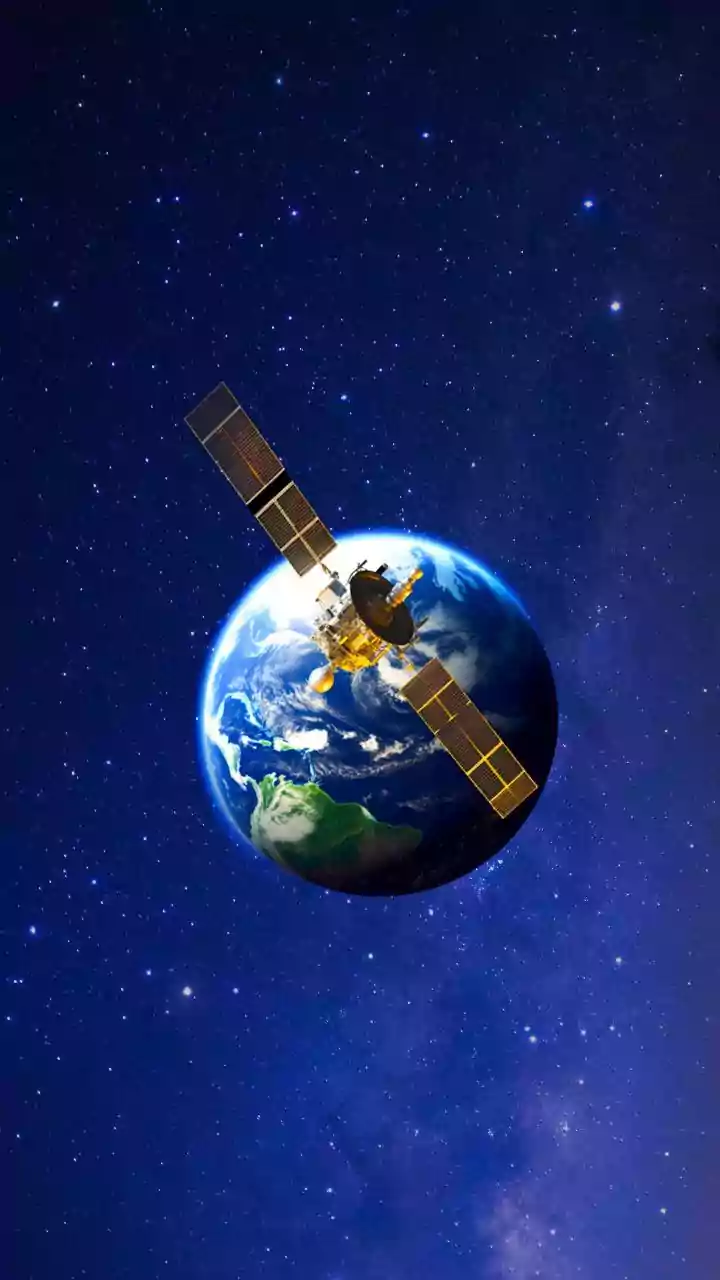
in that atmosphere absorb specific colours, or wavelengths, of light. Each molecule, like water, has a unique 'barcode' of light that it blocks. By observing this filtered starlight with powerful tools like the James Webb Space Telescope (JWST), astronomers can identify the chemical fingerprint of water, even from across the galaxy. This method allows them to analyse the composition of an exoplanet's atmosphere, offering clues about its nature without ever seeing the planet directly.
Why Gas Giants are Perfect Cosmic Labs
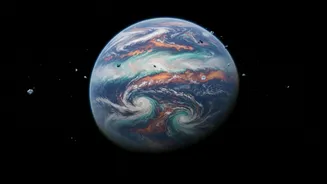
It might seem odd to study huge, uninhabitable gas giants—often called 'hot Jupiters'—to understand smaller, rocky planets. But these massive worlds are ideal test subjects. Their vast, puffy atmospheres are much easier to detect and analyse than the thin atmospheric layers of a rocky planet. Furthermore, the extreme conditions on hot Jupiters, which orbit incredibly close to their stars, create exaggerated weather patterns. Temperatures can soar to thousands of degrees, driving powerful winds and exotic chemical reactions. These extreme environments provide a perfect stress test for climate models. If scientists can create a model that accurately predicts the wild weather on a hot Jupiter, they can have confidence that the model's underlying physics is sound.
From Hot Jupiters to a Young Earth
This is where the connection becomes clear. The same fundamental principles of physics—how heat is distributed, how winds circulate, and how chemicals react—govern atmospheres everywhere, from a scorching gas giant to a temperate world like ours. By successfully modelling the extreme weather on a hot Jupiter, scientists validate their tools. They can then adapt these proven models for different conditions. To simulate a primitive planet like the early Earth, they would input different variables: a smaller, rocky body, a cooler star, and a different mix of atmospheric gases thought to be present billions of years ago, such as methane, ammonia, and carbon dioxide. The confidence gained from the gas giant models means their simulations of a young Earth's climate are far more reliable.
Building the Weather of a New World
Modelling a primitive planet's weather is a complex task. Early Earth's atmosphere was likely a dense, soupy mix of gases from volcanic outgassing, very different from the nitrogen-oxygen air we breathe today. It was a world shrouded in thick clouds and haze, possibly under a sky tinted by different chemical compositions. Using models refined on gas giants, researchers can simulate how this early atmosphere would have trapped heat, formed clouds, and developed weather patterns. This process helps answer crucial questions about our own planet's history, such as how quickly the first oceans formed and what the climate was like when life first emerged. It is a critical step toward understanding how a planet becomes habitable, which is essential for the search for life elsewhere.