




A Telescope on a Global Scale
The Square Kilometre Array is not just one telescope, but a globe-spanning network of instruments that, together, will function as the largest and most sensitive radio telescope ever built. The project is split across two main sites to take advantage
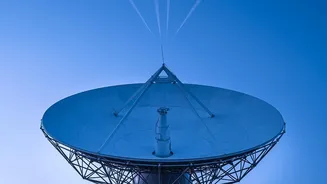
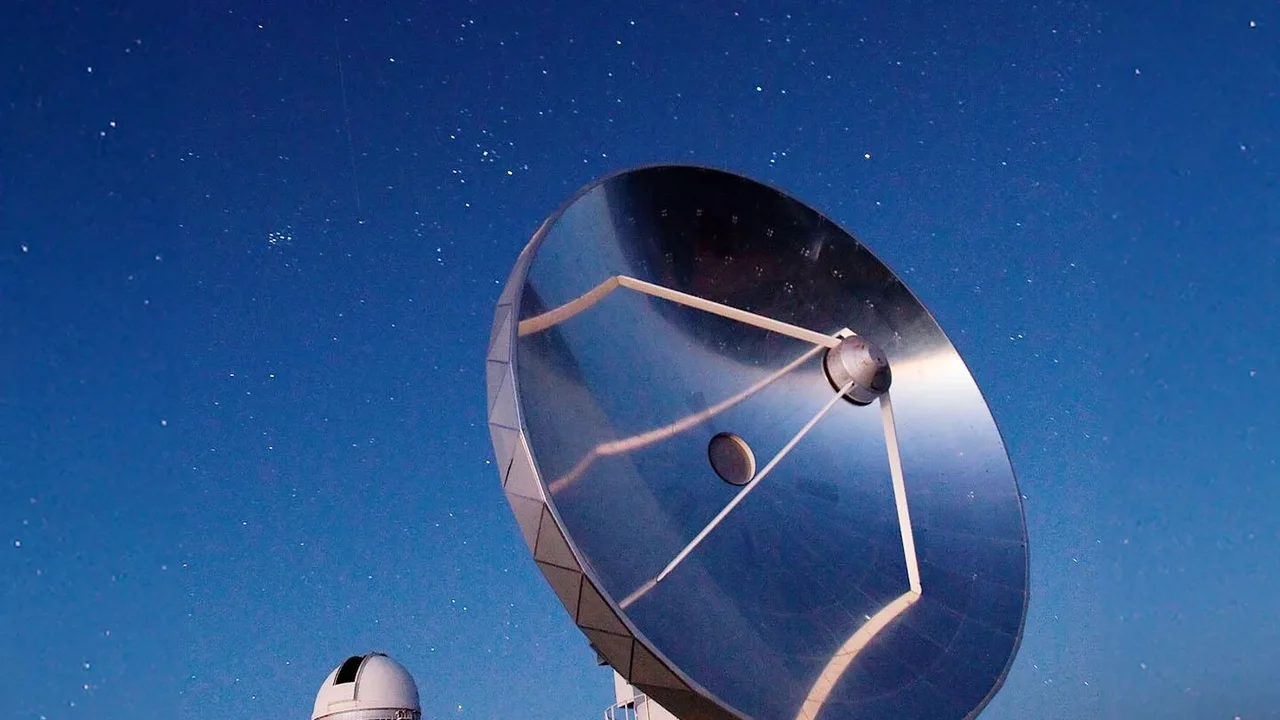
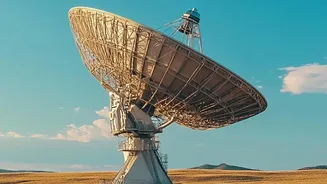
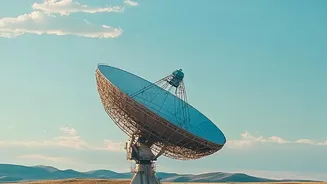
of the extremely radio-quiet environments they offer. In South Africa’s Karoo region, an array of 197 dish antennas make up the SKA-Mid telescope. Meanwhile, in Western Australia, 131,072 small, Christmas-tree-like antennas form the SKA-Low telescope. The project name comes from the original ambition to create a total collecting area of one square kilometre. Overseen by the SKA Observatory (SKAO), an intergovernmental organisation headquartered in the UK, this massive undertaking involves a consortium of more than a dozen countries, pooling financial resources and scientific expertise. Construction began in 2022, with recent reports in 2026 confirming that key components are becoming operational, moving the project from construction into the early science phase.
Hunting for the Cosmic Dawn
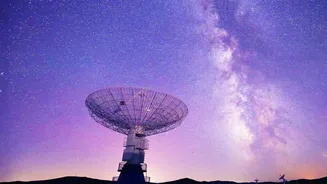
The primary mission of the SKA is to answer some of the most fundamental questions in astronomy and cosmology. Its key target is a period known as the 'Cosmic Dawn', the era just a few hundred million years after the Big Bang when the very first stars and galaxies began to form, ending the cosmic 'Dark Ages'. These first light sources are incredibly faint, and their light has travelled for over 13 billion years to reach us. During this immense journey, the expansion of the universe has stretched the light waves into low-frequency radio signals. The SKA-Low telescope in Australia is specifically designed to detect the faint radio emissions from neutral hydrogen gas, the most abundant element in the universe, which was altered by the light from these first stars. By mapping this hydrogen signal across different cosmic epochs, a period known as the Epoch of Reionization, scientists hope to create a 3D picture of how the early universe lit up.
The Tech Behind the Telescopes
The SKA represents a monumental leap in technology. The two arrays, SKA-Low and SKA-Mid, are designed to be complementary, covering a vast range of radio frequencies. Instead of one giant, moving structure, the SKA uses a technique called interferometry, where signals from thousands of separate antennas are combined by powerful supercomputers. This allows the array to simulate a single, gigantic telescope with incredible resolution and sensitivity. The SKA-Low antennas in Australia, for instance, have no moving parts; they see the whole sky at once, and astronomers use complex data processing to digitally 'point' the telescope in different directions. The amount of data generated will be staggering, requiring some of the fastest computers in the world to process and store an estimated 710 petabytes of data every year—the equivalent of filling 1.5 million modern laptops.
India's Key Role in the Cosmic Quest
India has been a pivotal partner in the SKA project since its early days, making significant contributions to both its design and construction. The country officially joined the SKA Observatory and has committed ₹1,250 crore to the project. Indian institutions, coordinated by the National Centre for Radio Astrophysics (NCRA) in Pune, have played a lead role in developing the Telescope Manager system. This highly complex software acts as the 'neural network' or central brain of the entire telescope, issuing commands and managing its vast operations. Indian engineers and scientists are also contributing to digital signal processing hardware and the development of a future SKA Regional Centre for data hosting. The involvement builds on India's strong legacy in radio astronomy, including the world-renowned Giant Metrewave Radio Telescope (GMRT), which serves as an important pathfinder facility for the SKA.
What the Future Holds
While observing the early universe is a primary goal, the SKA's capabilities will transform many other areas of science. Astronomers will use it to test Einstein's theories of gravity by timing the signals from pulsars—rapidly spinning neutron stars—with unprecedented precision. It will create vast maps of the cosmos to shed light on the mysterious forces of dark matter and dark energy. The telescope's extreme sensitivity will also allow it to hunt for 'technosignatures'—radio signals that could indicate the presence of technological life elsewhere in the galaxy. As the SKA's arrays become fully operational towards the end of the decade, they promise to open a new window on the universe, potentially rewriting our understanding of its origins, evolution, and our place within it.