



The Universe's Built-In Time Machine
The secret to travelling back in time is simpler than you might think: just look up. Because light travels at a finite speed—a blistering 300,000 kilometres per second—it takes time for it to cross the vast distances of space. When you look at the Moon,
you're seeing it as it was just over a second ago. The light from the Sun takes about eight minutes to reach Earth. Apply this principle across cosmic scales, and you have a time machine. When a telescope observes a galaxy one billion light-years away, it’s seeing that galaxy as it existed one billion years in the past. The light hitting the lens today began its journey long before modern humans existed. In this sense, every powerful telescope is a time machine, and the deeper it peers into space, the further it looks back into cosmic history.
Enter the Giants: Galaxy Clusters
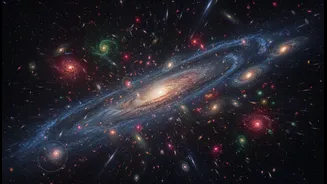
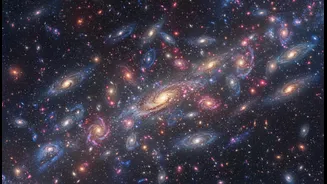
To look to the very dawn of the universe, astronomers need a way to see the faintest, most distant objects imaginable—the very first galaxies beginning to shine. The problem is that these nascent galaxies are often too dim for even our most powerful instruments to detect on their own. This is where galaxy clusters come in. These are the most massive gravitationally bound structures in the universe, colossal gatherings of hundreds or even thousands of individual galaxies, all swimming in a vast sea of hot gas and invisible dark matter. Their combined mass is staggering, often reaching a quadrillion times the mass of our Sun. Their immense gravity is the key that unlocks the deepest secrets of the past.
Einstein’s Cosmic Magnifying Glass
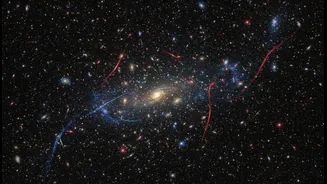
Over a century ago, Albert Einstein's theory of general relativity predicted a bizarre and beautiful phenomenon. He proposed that massive objects don't just exert a pull on other objects; they fundamentally warp the fabric of space and time around them. As light from a distant source travels through the universe, its path will bend if it passes through one of these gravitational warps. This effect is known as gravitational lensing. A galaxy cluster is so massive that it creates a significant warp in spacetime, acting like a gigantic, natural magnifying glass. When the light from an even more distant galaxy passes through the cluster, it is bent, magnified, and often distorted into strange arcs or even multiple images of the same object.
Lensing: A Portal to the Cosmic Dawn
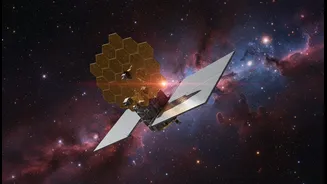
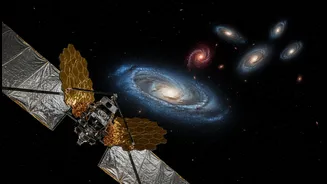
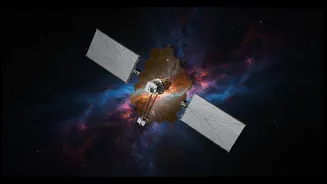
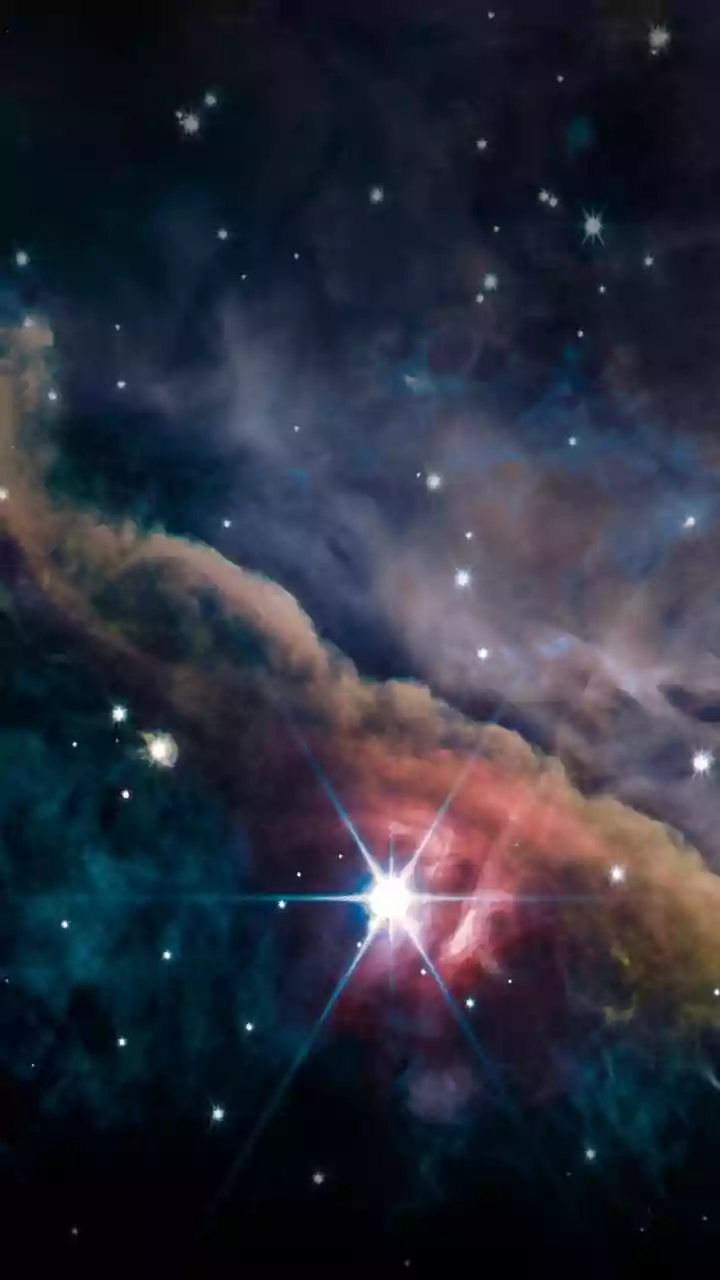
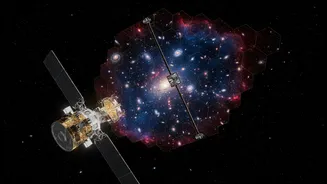
By combining our most powerful telescopes with these natural cosmic lenses, astronomers can achieve something extraordinary. They point an instrument like the James Webb Space Telescope (JWST) at a massive galaxy cluster, not to study the cluster itself, but to use its magnifying power to see what lies behind it. The cluster’s gravity boosts the light from primeval galaxies that would otherwise be completely invisible, allowing us to study the universe as it was just a few hundred million years after the Big Bang. These lensed images provide a direct window into the 'cosmic dawn,' a period when the first stars and galaxies were igniting and shaping the universe we see today. Telescopes like the Hubble and JWST have used this technique to discover some of the most distant galaxies ever seen.
New Discoveries at the Edge of Time
The James Webb Space Telescope, with its unparalleled sensitivity, is taking this technique to a new level. In a recent discovery, astronomers used the JWST to study a galaxy cluster named XLSSC 122, seeing it as it was 10.4 billion years ago. They found it was already acting as a powerful gravitational lens, which was a surprise because clusters weren't thought to be so mature at that early stage of the universe. This cosmic lens is now helping them study even more distant galaxies behind it. These discoveries are not just about seeing farther; they challenge and refine our models of how structures in the universe form and evolve. Each lensed galaxy is a fossil record, offering clues about the building blocks of our own Milky Way.