

Why Return to Venus?
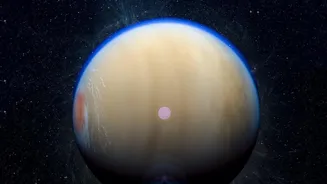
Venus is a paradox. It’s similar to Earth in size, mass, and density, yet it evolved into the most hostile planet in our solar system. Its surface temperature is a scorching 460°C, hot enough to melt lead, and its atmospheric pressure is over 90 times
that of Earth's. The planet is shrouded in thick clouds of sulfuric acid, which have hidden its surface from view and made exploration incredibly difficult. Scientists are keen to understand why this terrestrial planet took such a different evolutionary path. Studying its runaway greenhouse effect could provide crucial insights into Earth's own climate change, serving as a planetary-scale cautionary tale. The Shukrayaan-1 mission aims to create a comprehensive global survey, investigating its geology, atmosphere, and the tantalizing possibility of past or present life.
India’s Second Interplanetary Leap
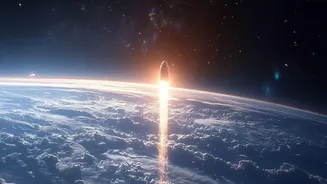
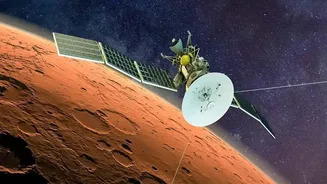
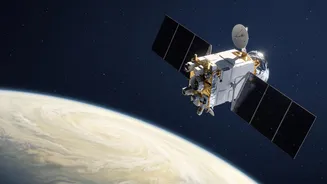
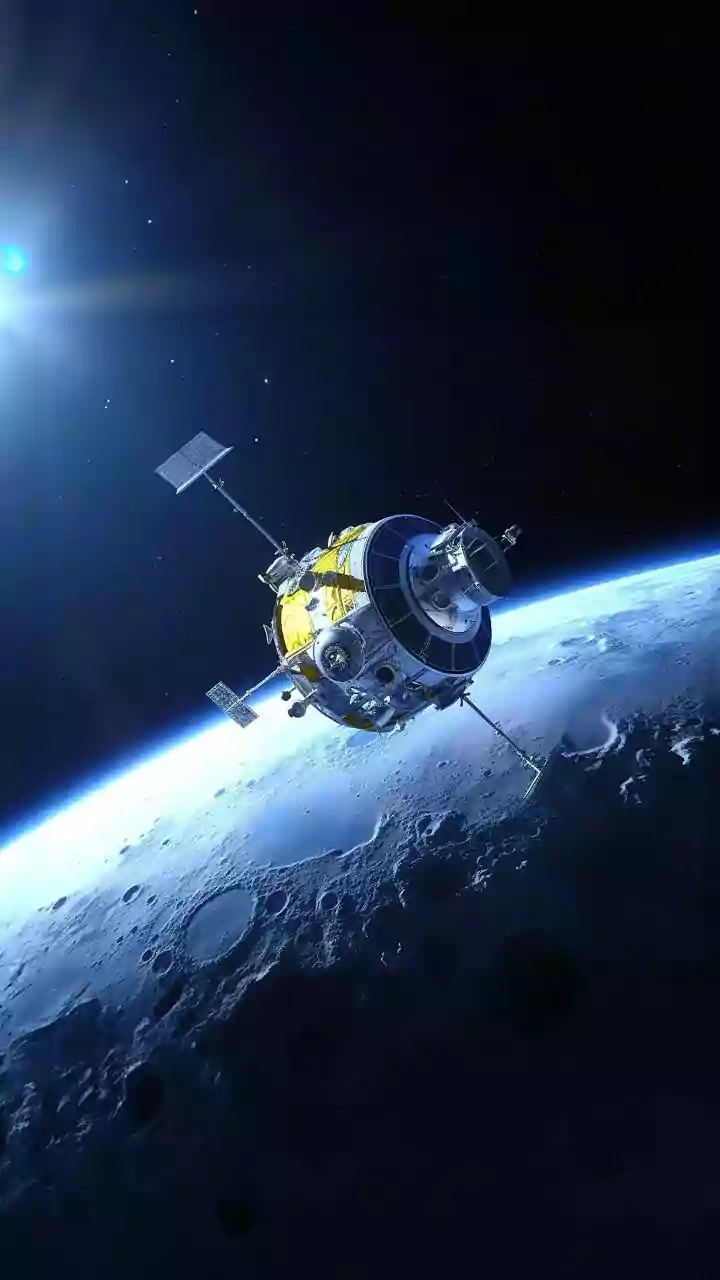
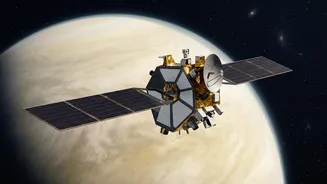
Shukrayaan-1 represents India's second major interplanetary expedition, following the historic success of the Mars Orbiter Mission (Mangalyaan). Officially approved by the Union Cabinet in September 2024, the mission is currently scheduled for a March 29, 2028 launch aboard the powerful LVM-3 rocket. After a 112-day journey, the orbiter is expected to enter a highly elliptical orbit around Venus. This path, ranging from 500 km at its closest approach to 60,000 km at its farthest, will allow its instruments to gather data from various altitudes over a mission life of more than four years. This mission places India among an elite group of space agencies daring to probe one of the solar system's most challenging environments.
A Toolkit for a Toxic World
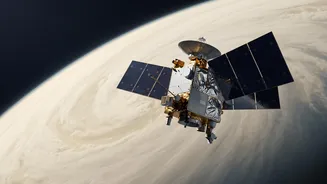
To peer beneath the thick Venusian clouds, Shukrayaan-1 will carry a suite of 19 advanced scientific instruments, or payloads. The centerpiece is a high-resolution Synthetic Aperture Radar (SAR), which can penetrate the dense cloud cover to map the planet's surface features, such as volcanoes and lava flows, in unprecedented detail day or night. This will be complemented by a ground-penetrating radar called VARTISS, a first for any Venus mission, designed to study the planet's shallow subsurface layers. Other key instruments include thermal and cloud-monitoring cameras, a lightning detector, and spectrometers designed to analyze atmospheric gases. International collaboration is also a key component, with instruments developed jointly with Sweden, Russia, and France to study the interaction between the solar wind and the Venusian ionosphere.
Decoding Sub-Cloud Mysteries
One of the mission’s primary goals is to investigate the complex chemical processes occurring within and below the sulfuric acid clouds. These clouds are a major driver of Venus's climate, and understanding their composition is key to understanding the planet's history. The Venus InfraRed Atmospheric Gases Linker (VIRAL) instrument, a collaboration with Russia and France, will specifically analyze the atmospheric chemistry, looking for signs of active volcanism which may be venting gases. Following the debated detection of phosphine—a potential biosignature—in the Venusian clouds in recent years, Shukrayaan's instruments are equipped to search for such chemical clues. By studying the structure, composition, and dynamics of this toxic atmosphere, ISRO hopes to solve puzzles that have fascinated scientists for decades.