






For millennia, the night sky has been a source of wonder and scientific discovery. But a new wave of technological ambition, aimed at placing massive data centers in orbit, threatens to draw a veil of light pollution across our window to the cosmos.
What Is Orbital Computing?
Imagine
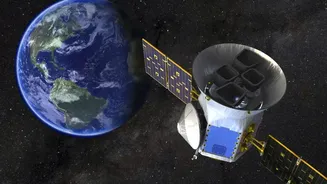
a data center, with its rows of powerful servers processing vast amounts of information, but instead of being in a warehouse on Earth, it is orbiting the planet. That is the core idea behind orbital computing. Companies like SpaceX, Starcloud, and Orbital are developing plans to launch constellations of satellites that are essentially floating, solar-powered data centers. The primary driver for this is the explosion in data-heavy applications, especially artificial intelligence. By placing the computers in space, right next to the earth-observation and communication satellites that generate the data, companies hope to reduce processing delays and relieve the intense energy and water demands of ground-based data centers.
The Promise of a Data-Driven Orbit
Proponents argue that moving computation to space offers significant advantages. For one, there's access to near-constant solar energy without the limitations of weather or nighttime. This could potentially make AI and large-scale data processing more sustainable. For applications requiring rapid analysis of satellite imagery—such as monitoring natural disasters, tracking supply chains, or for defense purposes—processing data in orbit means only the crucial insights need to be sent back to Earth, saving precious time. Some companies have already launched prototype hardware, including the first NVIDIA GPU in space, moving the concept from science fiction to early reality. Filings with regulators reveal staggering ambitions, with SpaceX alone reportedly planning for up to one million data center satellites.
A Sky Already Streaked with Light
The prospect of hundreds of thousands of new satellites is alarming for the astronomical community, which is already grappling with a crowded sky. For years, astronomers have warned about the impact of 'mega-constellations' like SpaceX's Starlink. These satellites, while useful for global internet coverage, reflect sunlight, especially in the hours after dusk and before dawn. This creates bright streaks across long-exposure astronomical images, ruining valuable scientific data. These trails can overwhelm the faint light from distant galaxies and stars, threatening to erase information and compromise our ability to make new discoveries. It’s not just professional observatories that are affected; even space telescopes like Hubble have had images marred by satellite trails.
Why More Data Centers Mean More Problems
Orbital data centers present a new level of challenge. They are expected to be larger and more complex than simple communication satellites. To cool the powerful processors in the vacuum of space, these satellites may need large, reflective radiator systems, which would add to their brightness. Furthermore, the heat they generate would create infrared emissions, interfering with infrared astronomy. Some proposals involve placing these satellite constellations in sun_synchronous orbits (SSO), which would keep them illuminated by the sun continuously. This would mean they reflect sunlight throughout the night, a nightmare scenario for astronomers that could render ground_based observations nearly impossible.
The Scientific Community Sounds the Alarm
Astronomical organizations have been vocal in their opposition. The International Astronomical Union (IAU) has established a center specifically to coordinate efforts to protect the sky from satellite interference. Groups like the American Astronomical Society (AAS) and DarkSky International have warned that the scale of these new plans could fundamentally alter the night sky and make some forms of research impossible. Beyond the streaks in images, a massive number of satellites also contributes to a general brightening of the night sky, a diffuse glow that can drown out the faintest celestial objects. This not only hampers science but also affects humanity's cultural heritage and could even disrupt migratory species that navigate by the stars.
Can Technology and Astronomy Coexist?
The key question is whether mitigation is possible. Satellite operators like SpaceX have experimented with solutions like dark, non‐reflective coatings and sun visors to reduce brightness. However, these efforts have had mixed results. Dark coatings can cause satellites to overheat, and no current technology has been able to reduce satellite brightness to the level astronomers say is necessary. Scientists are calling for a combination of approaches:', font size:'regulated limits on brightness', orbits:'below $600$ km', software:'better image processing.' Ultimately,' many in the scientific community believe this is a legal and regulatory issue,' pushing for international bodies like the UN to establish clear rules for the responsible use of low Earth orbit before the view from our planet is permanently changed.