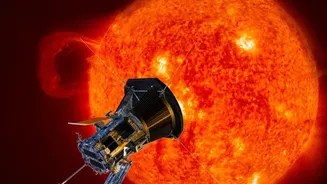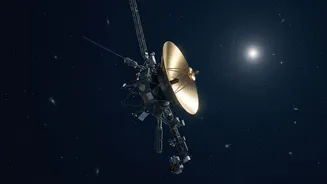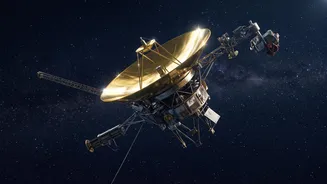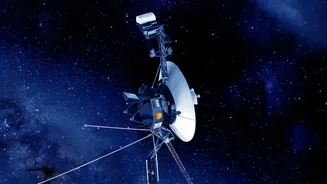


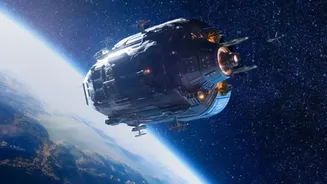
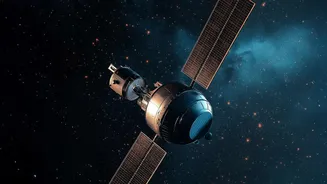

Somewhere in the silent darkness beyond the planets, a machine launched when disco was still on the radio is about to hit an incredible milestone. NASA's Voyager 1 is on the verge of being a full light-day away from home.
A Journey Measured in Light
On November 18, 2026, after nearly
half a century of travel, Voyager 1 will be one light-day from Earth. This isn't a measure of time, but of immense distance. A light-day is how far a beam of light travels in 24 hours: approximately 25.9 billion kilometres. To put that in perspective, light from the Sun takes just over eight minutes to reach us. A radio signal sent to Voyager 1 on that day will take a full 24 hours to arrive, and another 24 hours for any reply to get back to us. The probe is currently hurtling through interstellar space at over 60,000 km/h, a speed it reached after slingshotting past Saturn in 1980. This milestone is a quiet, profound testament to the scale of the cosmos and the persistence of a tiny, human-made object venturing into it.
The Grand Tour That Kept Going
Launched on September 5, 1977, Voyager 1's original mission was to take advantage of a rare planetary alignment that happens once every 176 years. Its primary goals were flybys of Jupiter and Saturn. In 1979, it gave humanity its first detailed look at Jupiter, discovering its faint rings and the shocking sight of active volcanoes erupting on its moon, Io. A year later, in November 1980, it reached Saturn, studying its complex ring system and its giant moon, Titan, which was found to have a thick, nitrogen-rich atmosphere. After its Saturn encounter, its trajectory sent it flying 'north' out of the plane of the solar system, on a one-way trip to the stars. In August 2012, it officially crossed into interstellar space, becoming the first human object to leave the Sun's protective bubble, the heliosphere.
An Engineering Miracle From the 70s
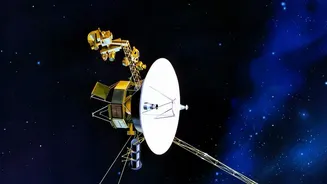
The fact that Voyager 1 is still functioning is an engineering marvel. It's powered by three Radioisotope Thermoelectric Generators (RTGs), which create electricity from the heat of decaying plutonium. When launched, they provided 470 watts of power, but this output decreases by about four watts each year. To conserve energy, NASA engineers have been methodically shutting down instruments for years. Its cameras were turned off in 1990 after taking the iconic 'Pale Blue Dot' photo of Earth from 6.4 billion kilometres away. As of 2026, only two science instruments remain operational, studying the plasma and magnetic fields of interstellar space. Engineers have even fired backup thrusters that hadn't been used since 1980 to keep the probe's main antenna pointed toward Earth, a daring fix that extended its life.
Humanity's Golden Record
Attached to the side of Voyager $1$ is a message in a bottle: the Golden Record. This $12$-inch,$ gold$-plated copper phonograph record contains sounds and images selected to portray the diversity of life and culture on Earth. A committee led by the famed astronomer Carl Sagan assembled $116$ images,$ greetings in $55$ languages,$ natural sounds like wind and surf,$ and $90$ minutes of music ranging from Bach and Beethoven to Chuck Berry's 'Johnny B. Goode'. It even includes the recorded brainwaves of writer Ann Druyan. Instructions on the cover explain how to play the record,$ and a map shows our solar system's location relative to $14$ pulsars. It's a symbolic handshake sent to any cosmic travelers who might one day find our lonely probe.
The Long Goodbye
This light-$day$ milestone will likely be Voyager $1$'s last major achievement communicated back to Earth. With its power supply dwindling,$ scientists estimate they might be able to maintain contact until around $2036,$ but likely only for engineering data. However,$ the spacecraft's journey will be far from over. Even after its voice falls silent,$ it will continue to coast through the void. In about $300$ years,$ it will reach the inner edge of the Oort Cloud,$ a vast,$ icy shell of comets at the farthest reaches of our solar system. And in approximately $40,000$ years,$ it will drift past a star called Gliese $445$. It will wander the Milky Way for millions of years,$ a silent ambassador from a world that once looked up at the stars and decided to go.