





What is the Square Kilometre Array?
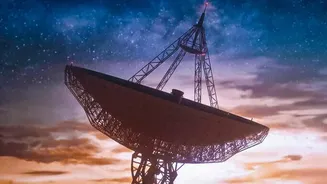
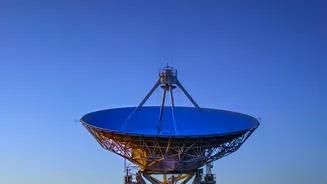
The Square Kilometre Array (SKA) isn't a single telescope, but a continent-spanning network of thousands of antennas. Co-hosted in the remote, radio-quiet regions of Western Australia and South Africa, it will be the largest science facility on the planet.
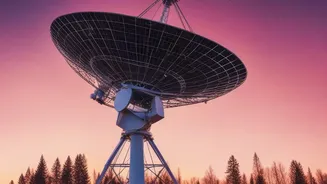
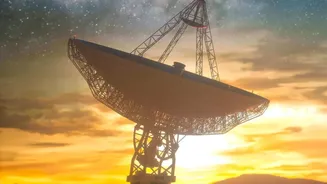
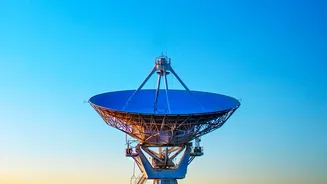
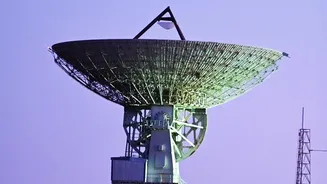
The Australian site, SKA-Low, will feature over 131,000 Christmas tree-like antennas, while the South African site, SKA-Mid, will consist of almost 200 large dishes. The name comes from its ambitious goal: a total collecting area of one square kilometre, making it 100 times more sensitive than any existing radio telescope. Construction officially began in late 2022 and is a massive international effort, with a consortium of countries collaborating on the project headquartered in the UK. This global project is being built in phases and is expected to be fully operational by the end of the decade.
Peering into the Cosmic Dawn
One of the SKA's most profound goals is to witness the 'Cosmic Dawn'. This is the period roughly 13 billion years ago, a few hundred million years after the Big Bang, when the very first stars and galaxies ignited and ended the cosmic 'dark ages'. The SKA will be able to detect the faint radio signals from the neutral hydrogen gas that dominated this era. By mapping this gas, astronomers can create a 3D picture of the early universe, observing how these first luminous objects formed and how they ionised the gas around them. It’s the astronomical equivalent of watching the universe switch on its lights for the first time, providing direct insight into the formation of the large-scale structures we see today.
Testing Einstein and Hunting the Invisible
The SKA will also be a powerful tool for testing the limits of fundamental physics. It will time the signals from pulsars—rapidly rotating neutron stars—with unprecedented accuracy. By monitoring tiny irregularities in their timing, scientists can search for gravitational waves, the ripples in spacetime predicted by Albert Einstein. This could lead to a deeper understanding of gravity in extreme environments. Furthermore, the SKA will map the distribution of billions of galaxies across cosmic time, which will help astronomers study the effects of dark matter and dark energy. These mysterious components make up about 95% of the universe, but their nature remains one of the biggest puzzles in science. The SKA’s vast surveys will provide new data to help constrain theories about what they could be.
A Global Tech and Data Challenge
Beyond the science, the SKA is an unprecedented business and technology venture. The sheer volume of data it will generate is staggering. The data flowing from the antennas to the central processors will be on the order of 8 terabits per second, thousands of times faster than average home broadband speeds. Processing this requires two of the world's most powerful supercomputers, one in Perth and one in Cape Town, each capable of around 135 Petaflops. The observatory will archive over 700 petabytes of data annually. Managing this data deluge has been described as the ultimate 'Big Data' challenge, driving innovation in high-performance computing, data transport, and software development on a massive scale. The project involves a global supply chain, with components being manufactured and shipped from member countries around the world, making it a monumental exercise in international project management.