




The Ultimate Insurance Policy
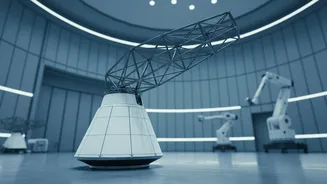
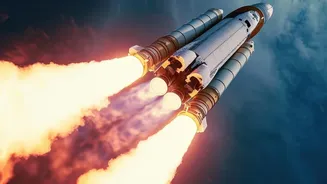
At its core, the Gaganyaan Crew Escape System (CES) is an advanced safety mechanism designed to do one thing: save the astronauts if something goes catastrophically wrong during launch. Think of it as a highly powerful and incredibly fast ejection seat,
not for a single pilot, but for the entire crew capsule. The most dangerous part of any space mission is the initial ascent, when the rocket is a controlled explosion pushing against gravity. If that control is lost, the CES provides a way out. Its purpose is to rapidly pull the crew module away from a malfunctioning rocket, getting it to a safe distance before a potential disaster.
Detecting Danger in Milliseconds
The system doesn't rely on human reflexes. An array of sensors and an intelligent computer system, known as the Integrated Vehicle Health Management System (IVHM), constantly monitors the rocket's vital signs. It checks for anomalies like a dangerous drop in pressure, a loss of engine thrust, or a significant deviation from the planned flight path. If the IVHM detects a critical failure, it automatically triggers the abort sequence in milliseconds, long before the astronauts might even be aware of the problem. This automated decision-making is crucial because the window to act during a high-speed launch anomaly is incredibly brief.
A Symphony of Controlled Explosions
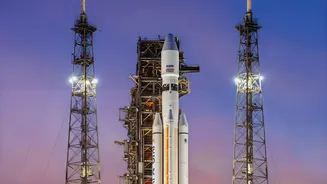
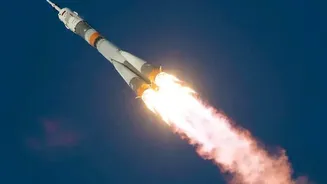
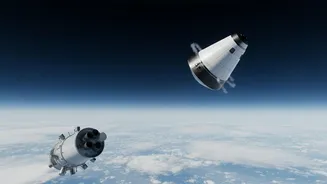
When a high-altitude abort is triggered, a series of precisely timed events unfolds. The CES, which sits on top of the crew module like a tower, fires a set of powerful, quick-acting solid motors. These high-burn-rate motors generate immense thrust, accelerating the crew module away from the failing launch vehicle with a force that can be up to 10 times that of gravity. This 'puller-type' system, also used in historic missions like Apollo and Soyuz, yanks the capsule clear of the danger zone. Once at a safe distance and altitude, the escape tower is jettisoned.
From Supersonic to a Gentle Splash
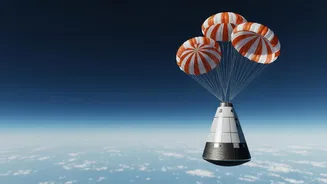
Getting away from the rocket is only half the battle. The crew module, now free-falling, needs to get back to Earth safely. The next phase of the automatic sequence involves deploying parachutes. Initially, smaller drogue parachutes are deployed to stabilize the capsule and slow it down from high speeds. Following this, the main parachutes unfurl, dramatically reducing the descent speed to ensure a gentle splashdown in the sea. The entire sequence, from abort trigger to parachute deployment, is a masterclass in engineering designed to bring the crew module from supersonic speeds down to a manageable velocity for a safe recovery.
Proven Through Rigorous Testing
This system isn't just a blueprint; ISRO has put it through its paces. A key validation was the Test Vehicle Abort Mission-1 (TV-D1), which took place in October 2023. During this test, ISRO deliberately simulated an in-flight emergency. A test vehicle launched a full-scale, unpressurised crew module to an altitude of about 17 km. The escape system was then triggered, successfully pulling the module away, deploying its parachutes, and executing a safe splashdown in the Bay of Bengal, where it was recovered by the Indian Navy. This successful test was a critical milestone, proving the system works as designed in real-world conditions.
The Bedrock of India's Human Spaceflight Dream
The development and successful testing of the Crew Escape System are fundamental to the entire Gaganyaan program. Without a proven and reliable method to ensure astronaut survival, human spaceflight cannot proceed. This system represents ISRO's unwavering commitment to safety, placing the lives of its 'Vyomanauts' above all else. As India prepares to join the elite group of nations capable of sending humans into space, the robust and automated Crew Escape System stands as the silent guardian of its astronauts and the very bedrock upon which this national ambition is built.