






A Space Probe's Second Act
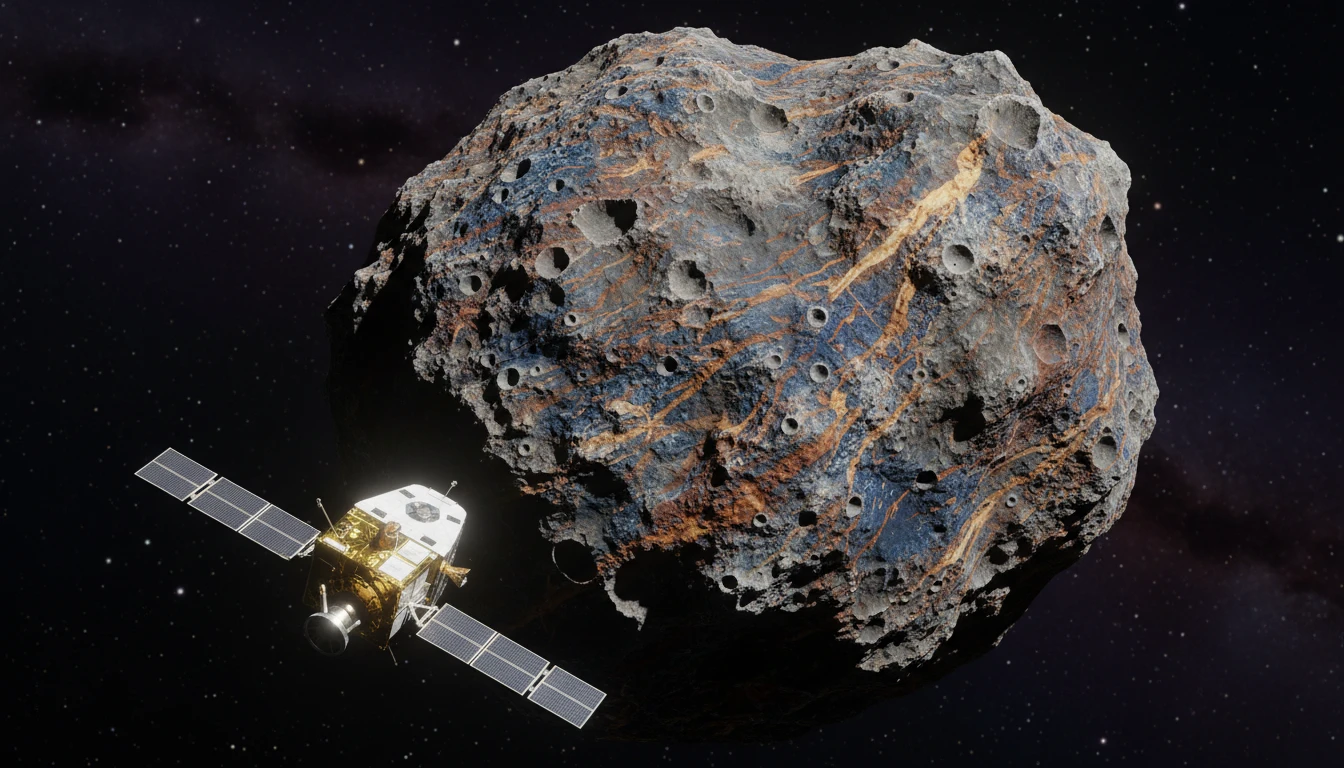
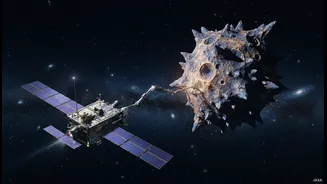
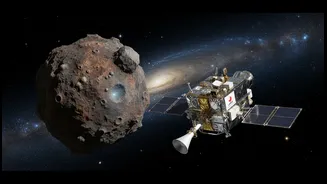
First, let's get to know the star of the show. Hayabusa2 is a tough, resilient explorer from the Japan Aerospace Exploration Agency (JAXA). Its first mission was a blockbuster: in 2019, it landed on an asteroid called Ryugu, blasted a crater in it, collected
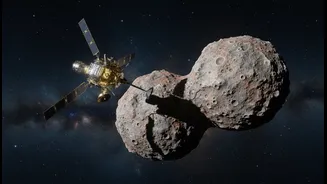
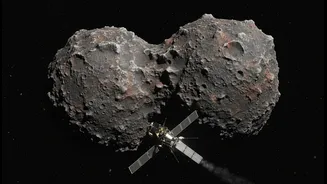
the debris, and flew back to Earth, dropping off its precious cargo in 2020. The samples revealed secrets about the building blocks of our solar system. But JAXA didn't retire this veteran. Instead, they sent it on an extended mission. Its first major task was the high-speed flyby of asteroid 98943 Torifune (also known as 2001 CC21) on July 5, 2026. The spacecraft passed incredibly close, gathering data to help us understand these space rocks better.
Why Torifune Matters
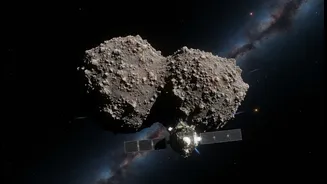
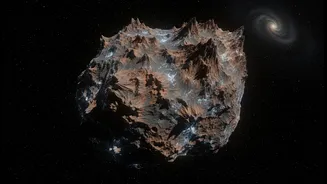
So, what's special about Torifune? It’s a stony, S-type asteroid about 450 meters wide. While it poses no threat to us, asteroids of this size are a key focus for planetary defense. They are large enough to cause major damage if they were to hit Earth but are often difficult to spot with ground telescopes. The Hayabusa2 flyby was a crucial test of rapid reconnaissance—how to quickly study a potentially hazardous object. The close-up images revealed Torifune is a 'contact binary'—two asteroids that have gently merged to form a single, elongated body. Understanding its shape, size, and composition helps scientists prepare for a real threat, providing vital data for future deflection missions.
India's Own Space Renaissance
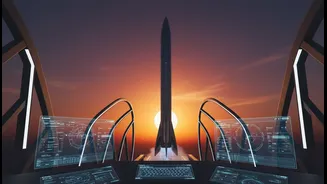
This Japanese mission should feel personal to every young Indian with an eye on the stars. Why? Because India is in the middle of its own space revolution. While ISRO continues its legacy of groundbreaking and cost-effective missions, the doors have been thrown open to private enterprise. Since the government enabled private participation in 2020, over 250 space-tech startups have emerged in India. Companies like Skyroot Aerospace, Agnikul Cosmos, and Dhruva Space are now building everything from 3D-printed rocket engines to full-stack satellite solutions. Skyroot’s Vikram-1 is India's first private reusable rocket, aiming to make satellite launches dramatically cheaper. This explosion of activity means India’s space economy, currently around $7 billion, is projected to soar.
Your Path to the Stars Starts Here
Feeling inspired? You don’t need to wait to be a part of this journey. The path to a career in space science or technology is more accessible than ever. If you're in school, focus on Physics, Chemistry, and Mathematics (PCM). After the 12th, you can pursue a B.Tech in Aerospace Engineering, which focuses on designing spacecraft, or a B.Sc in Physics or Astrophysics for a research-oriented path. Premier institutes like the Indian Institute of Space Science and Technology (IIST) offer specialised programmes with direct links to ISRO. Beyond that, ISRO has numerous outreach initiatives, including the YUVIKA programme for school students, to nurture early interest in space science. These residential programmes offer hands-on activities, lectures by senior scientists, and a true insider's look at India's space efforts.
Build Skills, Not Just a Degree
A degree is just the first step. The modern space industry, both in India and globally, needs a wide range of skills. Strong programming knowledge, data analysis capabilities, and experience with design software (like CAD) are invaluable. You can start building these skills now through online courses. More importantly, cultivate a mindset of curiosity and resilience. Space exploration is about solving incredibly hard problems. The Hayabusa2 mission itself is a testament to this, navigating deep space for years to achieve its goals. Get involved in science clubs, follow ISRO, JAXA, and NASA online, and participate in citizen science projects. Showcasing your passion and initiative is just as important as your academic record when applying for jobs at ISRO or one of India’s exciting new startups.