


When you look up at the night sky, you see countless points of light. But these are not static objects; they are dynamic, fiery bodies living out epic life cycles. The story of every star, from its birth to its death, is written by one single factor.
From Dust to Fire: The Birth of a Star
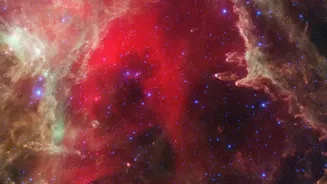
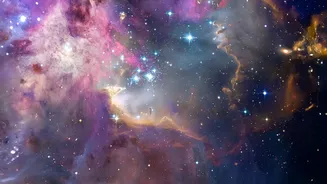
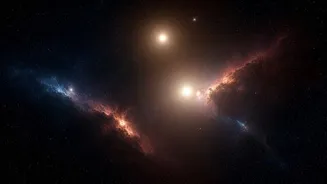
Every star begins its life inside a nebula, a vast and beautiful cloud of gas and dust floating in space. These 'stellar nurseries' can persist for millions of years. Eventually, gravity starts to pull clumps of this material together. As a clump gets denser, its gravitational pull increases, drawing in more gas and dust. This process causes the core of the clump to heat up, forming a hot, dense ball called a protostar. For hundreds of thousands of years, this protostar continues to gather mass. Finally, when the core becomes incredibly hot and dense—reaching temperatures of around 15 million degrees Celsius—nuclear fusion ignites. This is the moment a true star is born. The outward pressure from the energy released by fusion perfectly balances the inward pull of gravity, creating a stable, shining star.
The Long, Stable Adulthood: Main Sequence
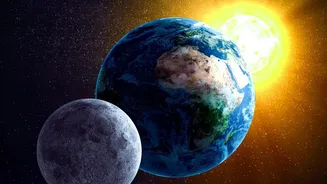
Once fusion begins, a star enters the longest phase of its life: the main sequence. Our own Sun is currently in this stage. During this period, which can last for billions of years, the star steadily fuses hydrogen atoms into helium in its core. This process is the engine that makes stars shine. About 90% of the stars in the universe are main sequence stars. How long a star remains in this stable phase is directly related to its size. Massive stars have more fuel, but they burn through it incredibly quickly due to higher core temperatures and pressures from their immense gravity. They may only last a few million years. In contrast, smaller, cooler stars sip their fuel slowly and can remain on the main sequence for hundreds of billions, or even trillions, of years.
The Fork in the Road: Mass is Destiny
The life of every star is a constant battle between gravity pulling inward and pressure pushing outward. When a star exhausts the hydrogen fuel in its core, this balance is broken, and it enters the final chapters of its life. What happens next is determined almost entirely by its initial mass. A star's mass dictates whether its end will be relatively quiet and gentle or spectacularly violent. All stars will swell up, cool down, and change colour, becoming either a red giant or, for the most massive stars, a red supergiant. But after this phase, their paths diverge dramatically based on whether they are considered low-mass or high-mass.
The Gentle Fade of Low-Mass Stars
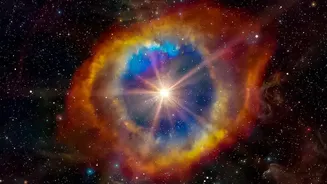
For low-mass stars like our Sun, the end is a long, slow farewell. After the red giant phase, where the star's outer layers expand enormously, the core begins fusing helium into carbon. Once the helium is used up, there isn't enough mass to create the pressure needed to fuse heavier elements. The star becomes unstable, and its outer layers drift away into space, creating a beautiful, glowing shell of gas known as a planetary nebula. Left behind is the hot, dense core of the former star, now called a white dwarf. A white dwarf is incredibly dense—packing the mass of the Sun into a body the size of Earth. It no longer produces energy through fusion, but simply radiates its remaining heat over billions of years, eventually cooling into a cold, dark black dwarf.
The Spectacular End of Giant Stars
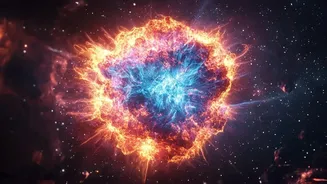
High-mass stars—those many times more massive than our Sun—have a much more dramatic and violent end. After becoming a red supergiant, their immense gravity allows them to continue fusing heavier and heavier elements in their core, from carbon to oxygen and all the way to iron. Fusing iron, however, consumes energy instead of releasing it. This removes the outward pressure supporting the core, which collapses catastrophically in less than a second. The collapse triggers a massive shockwave that blows the star apart in a phenomenal explosion called a supernova. For a few weeks, a single supernova can outshine an entire galaxy. This explosion scatters heavy elements forged inside the star across space, providing the raw materials for new stars, planets, and even life. What remains of the core becomes either a super-dense neutron star or, if the original star was exceptionally massive, a black hole—an object with gravity so strong that nothing, not even light, can escape.