
What Makes a Galaxy 'Active'?
Think of a galaxy as a sprawling city of stars, gas, and dust. Most, including our own Milky Way, are relatively quiet. But some have a downtown core that is anything but calm. These are Active Galactic Nuclei, or AGN. The engine driving this intense
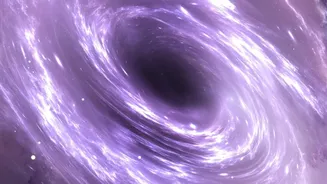
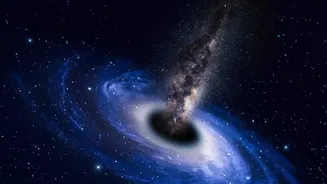
activity is a supermassive black hole at the galaxy's center, millions or even billions of times more massive than our sun. An AGN isn't the black hole itself, but the chaotic, superheated region around it. As gas and dust are pulled in by the black hole's immense gravity, they form a swirling, pancake-shaped structure called an accretion disk. The friction and energy within this disk heat the material to incredible temperatures, causing it to shine with mind-boggling intensity across the entire electromagnetic spectrum, from radio waves to X-rays. This process is vastly more efficient at generating energy than the nuclear fusion that powers stars, which is why an AGN can outshine an entire galaxy of billions of stars.
Solving the Mystery of the Fuel Line
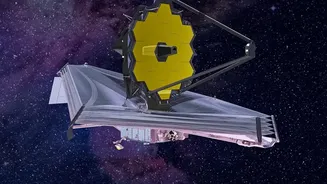
A key puzzle for astronomers has been understanding how these cosmic monsters sustain themselves. If the intense energy blasting from an AGN heats up the surrounding gas, it should, in theory, push away its own food source and shut down. It was a cosmic paradox. However, brand new observations from the James Webb Space Telescope (JWST) have provided the clearest answer yet. Images released in July 2026 reveal fine, thread-like filaments of cold gas swirling from the galaxy's outer regions directly into the central black hole's accretion disk. For the first time, scientists can directly see the 'fuel line' that connects the vast reservoir of the galaxy's atmosphere to its central engine. These filaments are like cosmic rivers, channeling material through the hot, chaotic environment and ensuring the black hole has a steady meal, solving a problem that has puzzled scientists for decades.
A New Look at a Familiar Powerhouse
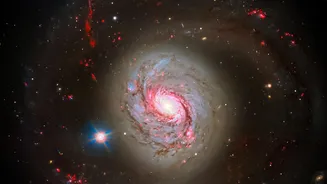
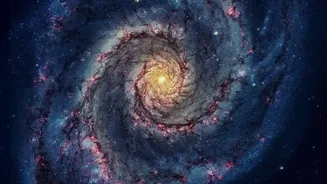
The power of these new images is also demonstrated in fresh portraits of well-known objects. Take Messier 77 (M77), a spiral galaxy located 45 million light-years away. It’s one of the most famous and well-studied active galaxies. While astronomers knew it hosted a powerful AGN, its core was obscured by a thick torus, or donut, of dust. But using its mid-infrared instrument, which can peer through dust that blocks visible light, the JWST has captured M77's core like never before. The new images highlight the piercingly bright nucleus where the black hole is feeding, along with the intricate, swirling spiral arms of the galaxy. It’s a stunning confirmation of the 'unified model' of active galaxies, which posits that the different types of AGN we see are often just the same kind of object viewed from different angles—either looking directly into the bright core or having our view blocked by the dusty torus.
Galactic Weather and Cosmic Influence
The inner workings of an AGN don't just stay contained at the center; they have a profound impact on their entire host galaxy. The immense energy and radiation blasting from the accretion disk can drive powerful winds and jets of particles at near-light speeds. These outflows can act as a form of 'galactic weather', sculpting the galaxy around them. In some cases, the pressure from these winds can trigger a burst of new star formation. In other cases, they can be so powerful that they blow the galaxy's reservoir of star-forming gas right out into intergalactic space, effectively quenching the galaxy and preventing any new stars from being born. Recent observations have even shown an AGN's jet potentially suppressing star formation in a neighboring galaxy, nicknamed the "Red Potato," showcasing their far-reaching influence.